Beginning in March 2008 and extending through the last Democratic primaries of early June, the United States witnessed the most brazen demonization in its history of a person based on his race, his creed, and his ties to a presidential candidate. One major purpose behind these attacks was to use the demonized figure to discredit the politician. But participation in the attacks also fed the voracious, twenty-four-hour-a-day media appetite, and quickly took on a life of its own. When we look back at the ugly spectacle then taking place, the evidence suggests that, despite much optimism about narrowing racial divides and an emerging “post-racial” consciousness, something much closer to the opposite had gripped America.
Of course, we are referring to the U.S. political class and establishment media’s treatment of the Reverend Jeremiah Wright and his relationship with Barack Obama. Contrasted with their handling of the Reverends John Hagee, Rod Parsley, and Pat Robertson and their links to John McCain, this episode provides an outstanding illustration of this country’s racism, chauvinism, and political biases.
Now retired from the Trinity United Church of Christ in Chicago—the “‘best representation’ of black liberation theology,” as James Cone told the New Yorker1—where he served as pastor for thirty-six years, Wright had known Obama for close to twenty of those years. Because of Obama’s membership in Wright’s congregation, Obama’s two coming-of-age books and numerous testaments about his relationship with Wright, and Wright’s early role in Obama’s presidential campaign, where until March 14, he was chairperson of its African-American Leadership Committee, both men had long anticipated the day when someone would use the big-city black preacher against the black candidate.2 “They’re going to associate your name with mine, and that could be detrimental,” Wright recounted in a PBS interview shortly after Obama announced his candidacy in February 2007. “[C]onservative bloggers and pundits have begun raising concerns about Wright’s Africentric theology and his liberal, some say radical, politics,” PBS added.3
ABC’s Good Morning America first triggered the avalanche of Wright coverage on March 13, when it played four short video-clips of “controversial statements,” and framed them with the leading question: “Could the reverend become a liability?”4 The next day, without referring to a single word from Wright, Obama issued a blanket condemnation: “I vehemently disagree and strongly condemn the statements that have been the subject of this controversy.”5 The following Tuesday (March 18) in Philadelphia, Obama delivered his “A More Perfect Union” speech on race in America.6 “[T]he discussion of race in this campaign has taken a particularly divisive turn,” he said, adding that he had “already condemned, in unequivocal terms, the statements…that have caused such controversy.” Obama even noted that Wright had a “profoundly distorted view of this country,” bending over backwards to repudiate anything that anybody finds offensive, no matter what Wright might have uttered, no matter how incisive. Noting that “This year, at least so far, the newsmaker from nowhere is Chicago minister Jeremiah Wright,” the Project for Excellence in Journalism (PEJ) likened Wright’s emergence “from obscurity to become a household word and an integral part of the media narrative” to the cases of Willie Horton (1988), Gennifer Flowers (1992), and the Swift Boat Veterans for Truth (2004).7 Although the PEJ failed to discuss what might link Wright to these three other cases, the “newsmaker from nowhere” had in fact become front-page news.
In one obvious sense, the transformation of Wright into an object of mass ridicule, and this object’s use, in turn, as an emotional “issue” to try to scare white Democratic primary voters away from Obama, into the arms of his rival, Hillary Clinton, belongs to a recurring strategy in U.S. presidential politics. As Kevin Phillips, a key adviser to Nixon’s successful 1968 campaign, explained the “Southern Strategy,” the more the “national Democratic Party [became] the Negro party throughout most of the South,” the more this fact “push[ed] whites into the alternative major party structure—that of the GOP.” Beginning with the U.S. Supreme Court’s 1954 decision against “separate but equal” in Brown v. Board of Education, and carried across the South by the civil rights movement, the federal government’s pressures to desegregate southern schools, and culminating in the Civil Rights and Voting Rights acts of 1964–65 under Lyndon Johnson, Republican campaigns seized upon these institutional changes to reap the political backlash among white, traditionally Democratic voters, whose defections to Republican candidates would prove decisive in several elections going forward. The “Democratic identification with the Negro social and economic revolution precipitated [the Republican] party’s best gains,” Phillips explained. “Negro-Democratic mutual identification was a major source of Democratic loss…in many sections of the nation.”8
But the Wright case is also reminiscent of how the media have swarmed around other Democratic hopefuls the past three decades, when the scent of vulnerability hung in the air. These include Jesse Jackson Sr. in early 1984 over his use of the pejorative “Hymietown” for New York City; Gary Hart in May 1987 over an extramarital relation; Michael Dukakis in 1988 over Willie Horton, a black felon in the state of Massachusetts who, during a weekend furlough while Dukakis was governor, escaped to Maryland where he attacked a white couple in their home; Bill Clinton in 1992 (and throughout his entire presidency) over his extramarital relations; Al Gore in 1999–2000 over his alleged claim to have “invented the Internet” Howard Dean in January 2004 over the fallout from what became labeled the “scream” speech following his third-place finish in the Iowa caucuses forcing him out of the primaries; and, last but not least, the success enjoyed in 2004 by the Swift Boat Veterans for Truth group in sowing lies about John Kerry’s Vietnam War service record.9
Yet, the same media that leapt at the chance to repeat these stories paid very little attention to George Bush’s evasion of the Vietnam War draft and his preferential treatment and failure to meet his legal obligations while a member of the Texas Air National Guard.10 Meanwhile, in 2007–08, Obama has placated establishment critics on virtually every policy front imaginable, the candidate of “change we can believe in” has visited interest group after interest group to promise them that they needn’t fear any change in the way they’re familiar with doing business.11 Nevertheless, Obama’s race, his background, his enthusiastic, youthful, and less predictable constituency, and the occasional slivers of populism that creep into his campaign, make the establishment nervous, whereas Hillary Clinton and John McCain clearly posed no such threats. And like George Bush, John McCain is portrayed as an earthy, chummy, straightforward kind of guy—indeed, as a “maverick” whose associations with lobbyists, the military-industrial complex, and some of the genuinely reactionary forces of U.S. society do not elicit the kind of focused attention directed at Obama and most everything he touches or that touches him.12
Constructing the Black Preacher
By now, the sermons, lectures, and commentaries of Jeremiah Wright quoted, reproduced, and discussed by other sources, ranging from broadcast and cable television and radio, to print and, of course, weblogs and the Internet-based audio- and video-hosting platforms such as YouTube, have been so numerous that sheer scale alone makes it impossible to define where his allegedly “controversial” and “offensive” statements begin, and where they end. But the relative intensity of coverage tells part of the story. According to the Project for Excellence in Journalism, for the first 125 days of 2008 (January 1–May 4), the Wright-Obama relationship was the most frequently reported news item, receiving roughly 3.8-times more attention than did the second most frequently reported item, how the “superdelegates” were aligning in the primary process; it was covered 4.9-times as heavily as John McCain’s ties to lobbyists.13 Wright and his views also towered over the meager attention given to the views of Hagee, Parsley, and Robertson, and to their relationships with McCain. Media Matters for America reports that between February 27 and April 30—the 27th having been the date on which Hagee endorsed McCain in San Antonio while McCain was campaigning with Parsley in Ohio—the New York Times and Washington Post “published more than 12 times as many articles” mentioning Wright and Obama as they did mentioning Hagee and McCain. In terms of editorials and op-eds, the ratio was even greater—more than 15 to 1.14
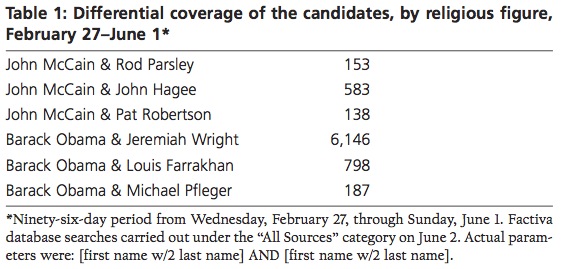
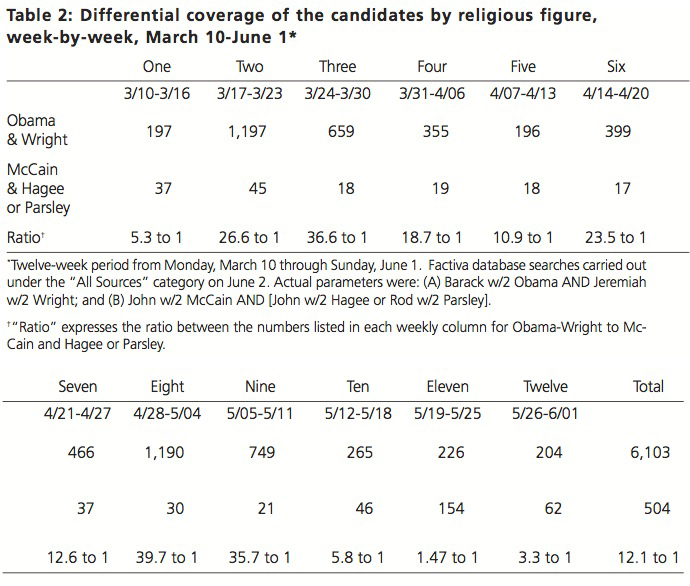
Similar patterns were true across the board. For the ninety-six-day period from February 27 through June 1, mentions of Wright’s name in conjunction with Obama’s outnumbered mentions of Hagee’s with McCain’s 10.5 times to 1; they also outnumbered mentions of Parsley’s with McCain’s 40.2 times to 1. (See table 1.) Remarkably, even the Reverend Louis Farrakhan’s name turned up in conjunction with Obama’s more frequently than did McCain’s with Hagee’s or Parsley’s—although Obama has had no connection with Farrakhan whatsoever. The Project for Excellence in Journalism reports that at the apex of its coverage (April 28–May 4), the Wright-Obama relationship “accounted for 42% of that week’s campaign stories,” while at its apex (May 19–25), the Hagee-McCain relationship “accounted for only 8%.”15 The next week (May 26–June 1), when Obama resigned from Trinity United Church of Christ after a video was circulated of the Catholic priest, Michael Pfleger, mocking Hillary Clinton during a guest sermon at the church, coverage of this “accounted for 13% of all the campaign stories.”16 Indeed, so obsessive and so recurring was the media’s focus on Jeremiah Wright, on Wright’s Trinity United, and on any person or topic that could be squeezed into this frame of reference and used to generate negative reporting and commentary about the black preacher and his ties to the black candidate, that even when the McCain campaign officially rejected the endorsements it had previously sought from Hagee and Parsley, nearly one-half as many more articles mentioned Obama-Wright than mentioned McCain together with Hagee or Parsley. (See table 2.) This reveals a deep bias of remarkable consistency.
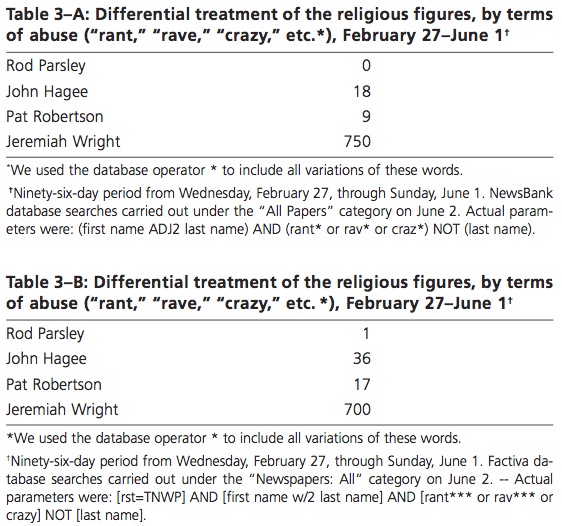
Another part of the story is the hostility expressed towards, and the derogatory language used in reference to, Wright—language seldom used for Hagee, Parsley, and Robertson (et al.). Wright “rants” and “raves,” and is “crazy” and “divisive” (etc.). “Wright’s ranting is going to hit white Americans with particular force,” Los Angeles Times media critic Tim Rutten observed. Wright’s sermons “mix left-wing conspiracy theories, phony Afro-centricism, remnant black power rhetoric and a rag bag of vulgar Third World sympathies in an angry, frequently race-baiting social gospel. Preached in a style that leaves little room for understatement, it’s alarming stuff when you hear it for the first time.”17
Aside from his quite accurate prediction about how white Americans would respond to Wright, what makes Wright’s sermons qualify as “ranting,” “conspiracy theories,” “phony,” “remnant,” “rag bag,” “vulgar,” “angry,” “alarming,” and the like, Rutten didn’t explain, nor did he feel any need to—he knew his readers would simply “get it.” Yet, in the same article, Rutten referred merely to Hagee’s “inconvenient views” about the Catholic Church being the “Great Whore of Babylon,” and to Clinton campaign adviser Geraldine Ferraro’s statement that “If Obama was a white man, he would not be in this position,” without any negative qualifier at all. As with close to 100 percent of his colleagues’ work during this period, whenever the media’s attention turned to Wright, the use of dismissive, highly insulting language came automatically to commentators, while an examination of the truth or falsity of what Wright actually said was regarded as unnecessary.
From the jingoistic right the denunciations were unrestrained: “anti-American, racist rantings” (National Review); “venomous and paranoid” (Ron Kessler); “grievance-mongering preacher animated by the voracity of hate” (Michelle Malkin); “hate-filled, anti-American black nationalism” (Shelby Steele); “black hate speech” and “racist rants” (Charles Krauthammer), “anti-American black supremacist” (London Times), “fatuous clerical rantings,” “black chauvinist rhetoric,” “foaming pastor,” “conceited old fanatic” (Christopher Hitchens); “stuck in a late-Sixties time warp” (Stanley Kurtz); among countless others like them.
But these were often matched and sometimes surpassed by the language of liberals: “histrionics of a loony preacher from the South Side of Chicago” (Bob Herbert); “ranting” and “fire-breathing pastor” (Frank Rich); “race-baiting diatribe” (Cynthia Tucker); a “self-centered jerk” who believes “It’s all about me” and whose “self-indulgent antics” belong on the American Idol television show (Rosa Brooks); the “jibberjabber from the crazy ex-minister” (Patricia Williams); “bigoted and paranoid rantings” (New York Times); “weirdness, wrath, insult, blowhardiness, vanity, paranoia, divisiveness and trouble” (Katha Pollitt). Last but not least, Barack Obama himself referred to Wright’s “ridiculous propositions,” “outrageous comments,” “very different vision of America,” as “divisive and destructive,” “something that not only makes me angry but also saddens me.”18
There were no comparable levels of anger and denunciation by the establishment media, or even by the liberals and left, over Parsley, Hagee, or Robertson, despite their prolific records of atrocious statements, their years of right-wing activism on behalf of the Republican Party, and the fact that McCain actively sought Hagee’s endorsement and referred to Parsley while campaigning with him in Ohio as “one of the truly great leaders in America, a moral compass, a spiritual guide.”19 (Obama did not seek Wright’s endorsement or declare him a moral compass and guide.) Thus for the same ninety-six-day period beginning February 27, snippets from Wright were characterized negatively as “ranting,” “raving,” or “crazy” (and the like) dozens of times as frequently as statements by Hagee and Robertson, and literally hundreds of times more often than those by Parsley. (See tables 3-A and 3-B.)
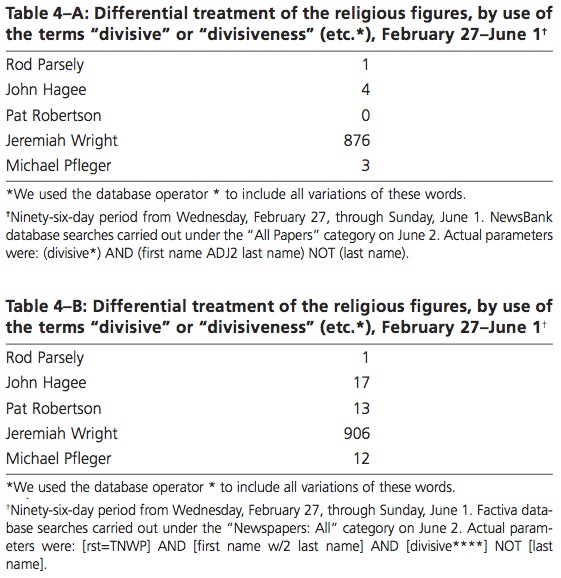
Another word used in this set of controversies, but almost exclusively in reference to Wright, Obama, and company is “divisiveness.” To be divisive means not simply to divide and separate, but to act out-of-order, to overstep proper bounds, to engage in unacceptable behavior, and above all to upset the wrong people. When Obama announced on April 29 that his break with Wright was final and complete, he said he found Wright’s appearance at the National Press Club “divisive and destructive,” and added “people are hungry to get out of the old divisive politics of the past.” Similarly, at the end of May, the Obama campaign issued a terse statement rejecting Pfleger’s “divisive, backward-looking rhetoric” and in the letter sent to Trinity United, informing the new pastor that his family was leaving the church, Obama explained, “Our relations with Trinity have been strained by the divisive statements of Reverend Wright.”20 Throughout the period February 27–June 1, the U.S. political class and the establishment media used the words “divisive” and “divisiveness” almost exclusively to characterize preachers associated with Barack Obama and/or Trinity United (but especially Wright and Pfleger), virtually never using these words for preachers associated with McCain (Parsley, Hagee, or Robertson) and Republican politics more generally. (See tables 4-A and 4-B.) Only Jeremiah Wright upsets the people who really matter.
What the Preachers Said
What, then, has Wright said that brought this storm of attention, anger, and ridicule down upon him? What is it about his words that make them uniquely “divisive”? And what have Parsley, Hagee, and Robertson said that could be criticized, but failed to generate comparable outrage or claims of divisiveness?
Wright indeed has made statements that strike us as false and not all of them trivial in their implications. One important case occurred during his interview with Bill Moyers on PBS in late April.21 Wright noted that Iraqi deaths from the U.S. war totaled some “100,000 [or] 200,000, depending on which count”—numbers that likely understate Iraqi deaths by factors anywhere from six to twelve times.22 But as this error minimizes the scale of U.S. government responsibility, and stays safely within a widely promulgated range that even George Bush might be able to swallow, nobody called Wright a “whackadoodle” for making it, nor used it to challenge Wright’s membership within the reality-based community. Despite the gravity of the topic, and what it means to Iraqis, Wright is as free as the rest of his fellow Americans to make mistakes of this kind. In fact, we have not seen evidence that any of his bitterest critics even noticed.
Not so with other kinds of errors, however. One in particular has circulated widely, and been treated with ridicule. This was when Wright asserted that the U.S. government “invented” or was responsible for the origin of HIV “as a means of genocide against people of color.”23 We do not know how long Wright has believed this, or how many times he has expressed something like it. We do know that Wright has long been an outspoken critic of the stigma associated with AIDS, in particular the belief that “AIDS is God’s curse upon the homosexual.”24 We also know that at this stage in the epidemic’s history, HIV/AIDS impacts black Americans more than any other U.S. ethnic or racial group, with blacks accounting for half of the AIDS cases diagnosed in 2006, nine-times the rate for white Americans, and more than half of AIDS-related deaths, even though blacks comprise only 12 percent of the national population.25 And we know that when a question about the origins of AIDS was put to Wright at the National Press Club—“Do you honestly believe your statement and those words?”—he replied (in part): “Based on the Tuskegee experiment and based on what has happened to Africans in this country, I believe our government is capable of doing anything.”26 Wright thus offers up the HIV claim while cataloging the oppression of black people in this country, including what has been called the “archetype of unethical research and racism in medicine,” the U.S. Public Health Service’s forty-year experiment with 600 black men in Macon County, Alabama (1932–72), 399 of whom suffered from syphilis but were left untreated, the officials following the disease’s progress in these men all the way to their deaths and autopsies.27
Yet, we are confident that Wright’s HIV error is not central to the attacks he has suffered. What is central are Wright’s extensive and effective broadsides against U.S. and Western (or white European) policies and pretensions, including his criticisms of the United States as an imperial superpower that rules the world by force, and robs from lesser powers in order to maintain its great wealth, without concern for the people it damages. Equally important is his view that the United States remains a racist society, its beneficiaries unwilling to surrender the material legacies of slavery, much less to make reparations for them.
Thus in stark contrast with Obama’s “post-racial” rhetoric, all of Wright’s “greatest hits” that have circulated over YouTube and similar platforms in 2008,28 and wound up reiterated ad infinitum, should be seen in light of Wright’s political critique of “500 years of colonialism, racism, and slavery”—themes painfully familiar to untold numbers of people, taken up and contested by liberation movements and by great literature throughout the ages. This encompasses Wright’s sermon in the aftermath of 9/11 that warned of the dangers inherent in seeking vengeance, and argued that 9/11 can only be understood as “America’s chickens coming home to roost”29 his assertion that the United States is “the No. 1 killer in the world,” and that when Americans kill, “nobody bats an eye” his “God damn America…for killing innocent people [and] for treating her citizens as less than human” and his assertions that the U.S. government “lied about weapons of mass destruction in Iraq” and “lied about a connection between al Qaeda and Saddam Hussein” that it supports Israel “shamelessly while ignoring the Palestinians and branding anybody who [speaks] out against it as being anti-Semitic” that this country “believe[s] in white supremacy and black inferiority” and that we ought to call this country the “United States of White America.”
Following Wright’s National Press Club performance, Alexander Cockburn noted that “95 percent of it makes total sense and is a breath of fresh air, as Wright ushers the Real America onto the stage, as opposed to the candidates’ flattering fictions.”30 But as these are precisely the fictions that powerful Americans cling to most dearly, Wright’s harsh criticisms of them place him beyond the pale for the establishment U.S. media and politicians vetted in the money primary.
Were the media concerned about prominent religious leaders who are politically active, whose ministries reach a lot of people, and who take outlandish stands on important issues, surely somebody would have connected the dots between the Republican Party’s years of disservice to the AIDS cause, and John Hagee’s assertion that AIDS is an “incurable plague” and “God’s curse against a disobedient nation.” Neither would anyone have forgotten the late Jerry Falwell’s gem, “AIDS is not just God’s punishment for homosexuals; it is God’s punishment for the society that tolerates homosexuals.” Nor that former Republican presidential candidate—and current McCain supporter—Pat Robertson campaigned in 1988 on a platform that included “some sort of quarantine of AIDS victims similar to those applied in the past in typhoid fever and hepatitis [cases].”31 And if the media were determined to uproot fanaticism wherever it is found, they would have noted that while only 15.2 percent of black Americans told researchers in 2005 that they believed “AIDS is a form of genocide against blacks,” as recently as 2007, 38 percent of white evangelical Protestants—the largest religious affiliation in the United States—affirmed that “AIDS might be God’s punishment for immoral sexual behavior.”32 Not content to blame HIV on a bio-weapons lab, this troubling percentage of Americans still saw AIDS as a form of pestilence—Hagee’s “curse of the plagues”—afflicting not just individuals, but whole countries that have fallen away from God.
In short, the charges levied by Wright against the United States are of a kind that nobody is free to express within the circles of American Power. If one wants to move within these circles, and to climb the many ladders to power and privilege they offer, one must remain silent about its flattering fictions or watch these ladders pulled away. A perfectly accurate assessment of 9/11, Wright’s “chickens coming home to roost” is received as an inestimably greater offense than are the “at least 935 false statements” by George Bush and seven of his regime’s top officials “in the two years following September 11, 2001,” as part of their “concerted effort” militarily to seize Iraq, and to replace the former regime with one of their own making—despite the devastating consequences of these lies.33 The same is true of the wild-eyed remarks by two of the GOP’s favorite preachers about the heavenly origins of 9/11:
Jerry Falwell: [T]he Lord has protected us so wonderfully these 225 years…[But] what we saw on Tuesday, as terrible as it is, could be miniscule if, in fact—if, in fact—God continues to lift the curtain and allow the enemies of America to give us probably what we deserve… The ACLU’s got to take a lot of blame for this…throwing God out successfully with the help of the federal court system, throwing God out of the public square, out of the schools. The abortionists have got to bear some burden for this because God will not be mocked. And when we destroy 40 million little innocent babies, we make God mad. I really believe that the pagans, and the abortionists, and the feminists, and the gays and the lesbians who are actively trying to make that an alternative lifestyle, the ACLU, People For the American Way—all of them who have tried to secularize America—I point the finger in their face and say “you helped this happen.”
Pat Robertson: I totally concur. And the problem is we have adopted that agenda at the highest levels of our government. And so we’re responsible as a free society for what the top people do. And, the top people, of course, is the court system.34
Nor did the media highlight the equally wild-eyed statements by other GOP preachers about Hurricane Katrina as the “judgment of God” against New Orleans for a “homosexual parade” the need for a “military preemptive strike to take out the nuclear capability of Iran for the salvation of Western civilization” (Hagee); the description of Islam as an “anti-Christ religion that intends, through violence, to conquer the world” (Parsley). Still less did it question the related claim that the United States was “founded, in part”—deriving its “divine purpose,” no less—from God’s “intention of seeing this false religion [i.e., Islam] destroyed” (Parsley).35
Because the men who preach these political sermons align closely with the institutions, policies, and party that Wright lambastes, their colossal gaffes and extremist prejudices, and the eventual outing in late May of Hagee and Parsley, proved nothing more than a minor bump along John McCain’s road, while Obama’s “pastor problem” is the kind that keeps on giving his enemies ammunition with which to attack.
Wright’s message being unacceptable in mainstream politics, not only was Wright vilified, but Obama himself was attacked for this association and felt immediate political pressure quickly and thoroughly to dissociate himself from the beyond-the-pale critic. It took a long time for McCain to do the same with his collection of religious extremist supporters, and interestingly his campaign only took this step after the disclosure one week before of an audio-clip in which Hagee preached that “what Hitler did in the Holocaust” was God’s plan to drive Europe’s Jews “back to the land of Israel.”36 Without this awkward disclosure, McCain might have remained silent, his religious team not having done anything truly beyond the pale like assailing U.S. racism, militarism, or empire building.37
We also believe that another reason liberals were harsh on Wright, beyond the fact that quite a few of them can’t stomach powerful criticisms of U.S. foreign policy and domestic inequalities and racism, is their fear that positions and rhetoric like Wright’s could jeopardize Obama’s chances in the 2008 election. Calling Wright a “distraction on the campaign trail,” Democratic Party strategist Donna Brazile lauded Obama’s Philadelphia speech, explaining that Obama “had to rebuke and distance himself from those comments.” Wright’s “Malcolm X-ism,” Maureen Dowd warned, has “dragged Obama into the ’60s maelstrom that [Obama] had pledged to be an antidote to.” In an interview with The Guardian titled “Do the right thing and shut up,” filmmaker Spike Lee complained that “The more [Wright] opens his mouth, the more damage he does.” Lee continued: “It makes me question his motives for talking. I’m starting to wonder whether somebody has been contributing to the building funds of his church. Seriously.” Similar expressions of anger were common in liberal quarters. Wright was egocentric, narcissistic, divisive, indeed, crazy—all-for-Jeremiah and nothing-for-Barack. As Arianna Huffington complained to Charlie Rose, “I think Jeremiah Wright obviously has a tremendous responsibility for derailing this campaign.”38
Southern Strategies
On June 11, 1963, George Wallace, Alabama’s newly elected governor, stood in the doorway to Foster Auditorium on the Tuscaloosa campus of the University of Alabama, where registration for summer classes was being held. A federal court had ordered the desegregation of the university; Wallace swore that he’d never let it happen. Even though Wallace backed down that day, and Vivian Hood and Jimmy Malone became the university’s first black students, the episode “transformed [Wallace] into a major player in American politics,” Dan Carter writes. Within one week, “more than 100,000 congratulatory telegrams and letters flooded the office of the Alabama governor.” Purportedly more than “half came from outside the South, and 95 percent supported” his stand. It was a “moment of epiphany” for Wallace. He “had looked out upon those white Americans north of Alabama and suddenly been awakened by a blinding vision: ‘They all hate black people, all of them. They’re all afraid, all of them. Great God! That’s it! They’re all Southern. The whole United States is Southern.’”39
Forty-five years later, race continues to impact the United States in powerful, though often less overt ways. By early June, the percentage of Americans dissatisfied with the “way things are going” reached 76 percent—a “record high,” Pew reported.40 One Wall Street Journal–NBC News poll found that by a margin of 51 percent to 35 percent, voters preferred the Democrats to win the White House in November rather than the Republicans.41 Gallup reported that 37 percent of voters identified themselves as Democrats, compared to 28 percent Republicans (with 34 percent independents/others).42 Such findings prompted the Journal (and many Republicans) to wonder whether U.S. politics was facing fundamental realignment “toward prolonged Democratic control”?43
And yet, according to Gallup’s daily tracking polls, John McCain and Barack Obama had been neck-and-neck from early March through the last week of July, both scoring in the low-to-mid 40-point range, with a narrow spread moving up and down between them, and the only departures from this pattern tied to specific but fleeting events, such as when Hillary Clinton withdrew from the Democratic primary in early June, and when Obama returned to the States after his grand tour of Afghanistan and Iraq, followed by stops in Israel, Jordan, Germany, France, and Britain.44
McCain’s relatively strong showing thus stood in sharp contrast with his party’s decline in popularity and its looming loss of congressional seats this fall, despite the fact that “On the issues, he is at odds with many voters.” But pollsters understood the reason: “More voters said they could identify with Sen. McCain’s ‘background’ and ‘values’ than with [Obama’s]… It underscores the extent to which his personality and image, rather than issues such as the war and the economy, could shape this presidential election.”45
Emphasizing this “campaign’s unusual dynamic,” a subsequent Wall Street Journal–NBC News poll deepened these findings. When asked whether each candidate “has a background and set of values that you can identify with,” 58 percent of voters said they could identify with McCain, while 47 percent said the same for Obama. Even more revealing, when asked “who do you think would be the riskier choice for president,” 55 percent said Obama, only 35 percent McCain. “One of [the McCain campaign’s] overriding themes is that [Obama’s] election would represent too big a risk for voters to take,” the Journal explained by way of a gloss on its finding.46 As summed-up by the Pew survey mentioned above: While “McCain’s negatives [were] mostly political, Obama’s [were] more personal.”
Managers of the two U.S. political parties are perfectly aware that both parties stand further to the right (i.e., are more elite-oriented) than does the general public on every issue of major import.47 This is why the parties find it necessary to resort to so many phony issues, and why their candidates run instead on the intangibles of character, values, patriotism, and the like: “Issues” such as these are readily fabricated, fuzzy, manageable, even adjustable from day to day, and each party knows well that its candidate would lose, were he to run on the basis of policies that cause serious harm to the majority of voters, but which each party is sure to implement.
For the first five months of 2008, the U.S. media devoted no more than 7 percent of its campaign coverage to “policy,” that is, to real issue-related stories, but a huge 78 percent to stories that focused on “horse race”-related affairs—strategy, who won and who lost, who lost whose temper, and what campaign tactics, ads, and gaffes the candidates may have committed.48 As Sheldon Wolin might say, the 2008 primaries were a “tribute,” not to the “vibrancy” of American democracy, but to “artifacts manufactured by money, organization, and the media,” and to their “utility in supporting a myth that legitimates the very formations of power which have enfeebled [American democracy].”49
During the Democratic primaries, the Clinton campaign failed to pry enough racially resentful white voters away from Obama to overcome his lead in delegates, which had already assumed what turned out to be its final shape during the middle weeks of February. But this was not because it did not try—much less because the “Southern Strategy” no longer works. Rather, it was because the Clinton campaign waited too long to employ its version of the strategy, as it was only from late February on that it began making the case to uncommitted “superdelegates” in particular that the Black Candidate could not prevail in the general election, so that it would be too risky for the Democratic Party to permit him to become its nominee.50 Although “electability,” the need to win in “swing” or “purple” states such as Florida and Ohio, and to find some way to collect the “magical 270” electoral college minimum was the rhetoric then in use, we cannot help but be struck by the implicit defense of the color line that lurked beneath all of this.
At the same time, by stirring up so many prejudices and fears around the Black Preacher, and by keeping his relationship with the Black Candidate at or near the top of the media’s campaign coverage for the last twelve weeks of the primaries, the Black Candidate’s standing was diminished among Hillary Clinton supporters, independents, and, in terms of presidential elections, that most important demographic of all, given their sheer numbers—white racists and white social reactionaries. Come November, this is bound to cause lingering effects, and threatens to play a self-fulfilling role in the outcome.
Before Barack Obama clinched his party’s nomination in the first half of 2008, a whole series of demands was made of him, quite unlike any other national candidate in memory. Louis Farrakhan had been the recipient of the Dr. Jeremiah A. Wright Trumpeter Award at Trinity United Church. This became “Obama’s Farrakhan Test,” about which the Washington Post’s Richard Cohen wrote that, “given who the parishioner is, the obligation to speak out is all the greater.” That very day, Obama issued a terse statement “decry[ing] racism and anti-Semitism in every form and strongly condemn[ing] the anti-Semitic statements made by Minister Farrakhan.”51 Then up popped Obama’s Wright Test—without question, his most arduous through the primaries. “Why did he stay a member of the congregation?” Clinton operative Lanny Davis demanded. “Why didn’t he speak up earlier? And why did he reward Rev. Wright with a campaign position even after knowing of his comments?”52 It took Obama at least four and maybe five acts of public expiation before he purged his old pastor, the last not completed until Obama’s Pfleger Test came at the end of May, when he finally left Trinity United for good.53
Notions of “tests,” of casting out, and of making amends, take us to the heart of socially sanctioned group behavior.
Because Obama had ties to people who, like Wright and Pfleger, are “divisive,” who traffic in dangerous ideas, and who do not know their proper places, Obama was compelled to sever those ties and promise never to associate with their kind again. Through the Democratic primaries, he did this unfailingly.
The fact that Barack Obama won the Democratic nomination is welcome evidence that the United States has traveled some distance since George Wallace’s “epiphany.” But we must not forget that the “racial divide” not only persists in this country, it is also strong and arguably “without peer,” revealing “two utterly dissimilar publics,” as Donald Kinder and Lynn Sanders write in a major study of the “differences in opinion between blacks and whites.” “[T]he most arresting feature of public opinion on race,” they believe, “remains how emphatically black and white Americans disagree with each other.” So fundamental is this divide, it expresses a “deep and perhaps deepening racial alienation.” In a careful study of the 1988 presidential campaign by the first George Bush, and the ways in which it used the image of Willie Horton to “blow up” the Michael Dukakis campaign (Republican strategist Lee Atwater’s phrase), they show that the “racial resentments” of white voters proved decisive in the defeat of Dukakis, and in their words “offered near-perfect illustration of the electoral temptations of race.”54
Modern Dixiecrats
A Dixiecrat meeting is the strangest type of political gathering of our time…
States Rights is the issue only insofar as it concerns the right of States to solve—or refuse to solve—their race problems. The real issue is one word, and that word is never spoken. It is one thought, and that thought is never expressed…
On the platform, Mr. Thurmond and his fellow travelers shout of Americanism, our way of life, the right to choose one’s associates, Communism, Reds. But they mean Nigger.
Now that the Democratic nomination is set and the general election draws near, it is the Republican attack machine’s turn. That machine, already large and impressively powerful twenty years ago, has grown in size, sophistication, and power, spreading as far as the explosive growth in new media will enable it. Nor can its effectiveness be doubted, as we saw just four years ago in the remarkable success of the Swift Boat Veterans at denigrating the naval record of Vietnam War veteran John Kerry when he ran for the presidency; and has been seen twice (2000 and then again in 2004) in the machine’s ability to help keep George Bush’s record of draft evasion and his going AWOL from the Texas Air National Guard out of the public arena.56
As we noted at the outset, a “Southern Strategy” in U.S. presidential politics is any attempt to persuade or entice or frighten racially bigoted, fearful, and resentful white voters—“Negrophobe whites,” in Kevin Phillips’ classic formulation—to flee the Democratic Party by identifying it with black minority causes (public school desegregation, say, and civil rights more generally). For more than forty years, this has meant the conscious marketing of the Republican Party (which still retains the image of the party of Lincoln) as the bastion of white majority interests. Southern strategies can be blatant, as when the “Dixiecrats” rose up in several Southern states in 1948, and defected from the Democratic Party to protest a civil rights program announced early that year by President Harry Truman as a way of countering Progressive Party candidate Henry Wallace’s more comprehensive proposal.57 “We stand for the segregation of the races and the racial integrity of each race [and] the constitutional right to choose one’s associates,” the Dixiecrats’ own platform countered. “We oppose the elimination of segregation, the repeal of miscegenation statutes, [and] the control of private employment by Federal bureaucrats called for by the misnamed civil rights program.”58 But a Southern Strategy can also be more refined—removed by varying degrees of separation between the rhetoric and imagery that it adopts and its white racist roots. Indeed, since the 1960s, this has been its most familiar form. Even when George Wallace made his stand in the schoolhouse door, the “proclamation” that he read from the podium that day made no mention of upholding the color line; instead, Wallace spoke of the need to protect “states’ rights,” and denounced “this illegal and unwarranted action by the Central Government” in Washington.59
The same was true for Barry Goldwater in 1964, Richard Nixon in 1968 and 1972, and Ronald Reagan in 1980 and 1984, who, as Dan Carter recalls, “showed that he could use [racially] coded language with the best of them, lambasting welfare queens, busing, and affirmative action as the need arose.”60 Reagan’s first campaign stop after winning the 1980 Republican nomination was the Neshoba County Fair in Philadelphia, Mississippi—the city where Freedom Summer activists Michael Schwerner, James Chaney, and Andrew Goodman had been “slain with the complicity of local police officials in 1964,” the press reported at the time. “Just as Goldwater had drawn virtually all-white audiences in the Deep South in 1964, so Reagan was greeted by a ‘crowd almost entirely made up of whites.’ He did not let them down. ‘I believe in states’ rights’, Reagan said… As [the Washington Post’s Lou] Cannon observed, ‘The visual statement of television the next day was a sea of white faces at the Neshoba Fair with Reagan’s words floating about them.’ The Mississippi event powerfully communicated Reagan’s sympathies and electoral targets in the rural Deep South.”61
Whenever candidates, parties, or media draw from the deep well of white racial solidarity and reaction to gains by black Americans, this is the kind of strategy they are executing—whether they are conscious of their true motives (as was Hillary Clinton’s primary campaign, and are the myriad of Swift Boat-like, negative attack Web sites that have sprung-up in 2008, warning against the “dark forces” taking over the Democratic Party, and pledging their support for anybody but the Black Candidate62) or not conscious of them in the least. From preserving racial segregation in the South sixty years ago, to maintaining the Republican hold on the White House in 1988 and 2008, the essential strategy remains constant. Even if it is not the whole United States that is “Southern,” in Wallace’s sense, what once worked so well across the Deep South has long since gone national, following extant racial cleavages and spread by old and new media alike.63
In the words of one cynic, the Black Preacher “has become the honorary chairman of McCain’s get-out-the-vote efforts… Wright will loom larger in the general election.”64 Of this we have no doubt. The savage dragging of Jeremiah Wright through the propaganda system in March, April, and May of this year shows how well-primed is a substantial percentage of the U.S. political class and media to carry out racial scapegoating and to pile on a collectively demonized figure. It also points ominously to much uglier tactics scheduled for the rest of the campaign.65
Only this time things are different. The emotionally potent caricatures of undeserving blacks to whom New Deal and Great Society Democrats have doled out big-government largesse at the expense of white, hardworking taxpayers, and the insidious, coded language and imagery behind which this mentality hides its true face when in public, no longer need to be bundled together and turned into “issues” about “state’s rights,” “welfare queens,” “quotas,” “free rides,” “affirmative action,” “special favors,” “grievances,” “pathologies,” “crime,” “drugs,” “gangs,” “public safety,” “personal responsibility,” and dozens of others:66 Barack Obama’s blackness takes care of everything.
Because Barack Obama is running for the presidency of a country built upon black slavery, white supremacy, ubiquitous color lines, and deeply-rooted race prejudices, the Republican attack machine has its easiest target to date. And this remains true no matter how obsequiously Obama’s campaign managers work to portray him. Or how much “unity” the stalwarts of today’s Democratic Party swear up and down behind him.
Anti-black racism was not created in 2008; and though it can be activated from above, it need not be imposed. Instead, its presence is always felt, echoing up and down U.S. history like the residue of the Big Bang that radio astronomers detect wherever they turn their antennae—only much louder. Before November 4 arrives, we still anticipate this election to turn into nothing less than a national referendum on whether the 66 percent of the U.S. population that is white (or the 88 percent that isn’t black) is willing to permit a Black Candidate to enter the White House.
Meanwhile, out of the image-dominated world of the American elite comes the marketing of Barack Obama, the candidate of “change.” But presidential elections afford scant prospects for real change in the United States, and certainly none in the fundamental structure of its society. No matter which party’s candidate wins at the polls, it is the vast majority of the U.S. and indeed global population that will continue to lose.
Notes
- ↩ Kelefa Sanneh, “Project Trinity: The perilous mission of Obama’s church,” New Yorker, April 7, 2008. For an open-minded, sympathetic portrait of Trinity, a “black congregation in a mainline white denomination,” see Julia M. Speller, Walkin’ the Talk: Keepin’ the Faith in Africentric Congregations (Cleveland: The Pilgrim Press, 2005), chapter 4, “Trinity United Church of Christ,” 72–102. The United Church of Christ is a progressive Protestant church with 1.4 million members and 6,000 congregations across the United States; Trinity’s 8,000 member congregation on Chicago’s far South Side makes it the largest within the UCC. Also see Gayraud S. Wilmore, Black Religion and Black Radicalism: An Interpretation of the Religious History of Afro-American People, third edition (Maryknoll, NY: Orbis Books, 1998); and C. Eric Lincoln and Lawrence H. Mamiya, The Black Church in the African American Experience (Durham, NC: Duke University Press, 1990), especially chapter 7, “The New Black Revolution: The Black Consciousness Movement and the Black Church,” 164–95.
- ↩ See Barack Obama, Dreams from My Father: A Story of Race and Inheritance, revised edition (New York: Three Rivers Press, 2004), chapter 14, 272–95; and The Audacity of Hope: Thoughts on Reclaiming the American Dream (New York: Crown, 2006). Following publication of the latter of these, in the second half of 2006, Obama never once shied away from attesting to Wright’s importance to his development. Although we ought to be skeptical about the authenticity of the protagonist depicted in these two political Bildungsroman, we cannot doubt that the figure of Jeremiah Wright looms large in their narratives. For a critique of what we call Brand Obama, the Black Candidate whose image has been crafted specifically to appeal to white voters with an eye toward winning a presidential election, see Paul Street, Barack Obama and the Future of American Politics (Boulder, CO: Paradigm Publishers, 2008). Also see Glen Ford, “Obama Insults Half a Race,” Black Agenda Report, June 18–24, 2008; and Adolph Reed, Jr., “Where Obamaism Seems to be Going,” Black Agenda Report, July 16, 2008.
- ↩ Kim Lawton, “Link between Senator Barack Obama and Reverend Jeremiah Wright of Trinity United Church of Christ issue in presidential campaign,” Religion and Ethics Newsweekly, PBS, March 9, 2007.
- ↩ Brian Ross and Rehab El-Buri, “Obama’s Pastor: God damn America, U.S. to blame for 9/11,” Good Morning America, ABC television, March 13, 2008. ABC claims to have reviewed “more than a dozen sermons…offered for sale by the church.” Here we note that the four video-clips broadcast this day totaled a mere 156 words in all—roughly the length the New York Times permits for one letter to the editor.
- ↩ Barack Obama, “On My Faith and My Church,” Huffington Post, March 14, 2008, as posted to the Obama ’08 campaign Web site.
- ↩ Barack Obama, “A More Perfect Union,” Obama ’08 campaign Web site, March 18, 2008.
- ↩ Mark Jurkowitz, “The Pastor’s Press Tour is the Week’s Big Newsmaker,” Project for Excellence in Journalism, April 28–May 4, 2008, 1.
- ↩ Kevin P. Phillips, The Emerging Republican Majority, second edition (New York: Anchor Books, 1970), 286–87, 32, 468.
- ↩ For one early source that reported each of these seven stories, see: Rick Atkinson, “Peace With American Jews Eludes Jackson,” Washington Post, February 13, 1984; Jim McGee and Tom Fielder, “Miami Woman Is Linked to Hart: Candidate Denies Any Impropriety,” Miami Herald, May 3, 1987; Robert Healy, “Turning negative into positive for Bush,” Boston Globe, September 7, 1988; Gareth Pownall, “Bush Rival in Beauty Queen Sex Scandal,” Daily Mail (UK), January 17, 1992; Rowan Scarborough, “Gore Internet gaffe gives critics club for campaign,” Washington Times, March 16, 1999; Al Kamen, “A Meltdown in History,” Washington Post, January 21, 2004; and Jason Zengerle, “The Vet Wars,” New York Times Magazine, May 23, 2004.
- ↩ One crucial difference between establishment treatment of right-wing-friendly policymakers and their more liberal counterparts is that initial reports of wrongdoing by the former are typically met with aggressive efforts to discredit the reports, to smear the reporters, and to scare others away from taking up the same investigation. In the case of CBS Television’s September 2004 report that George Bush received preferential treatment during his tour with the Texas Air National Guard, CBS Evening News anchorman Dan Rather eventually was forced to issue a formal apology to Bush over the air (September 20, 2004), and he and four others involved in the production of the original 60 Minutes II segment (September 9, 2004) were either fired or forced to resign. (See note 56, below.)
- ↩ Three examples of the Obama campaign’s eagerness to cater to a reactionary status quo will suffice. (1) On May 23, Obama spoke about “U.S. policy toward the Americas” before the Cuban American National Foundation in Miami. “There is no place…for tyranny in this hemisphere,” he said. He promised to “maintain the embargo” against Cuba (“Never in my lifetime have the people of Cuba known freedom”) while allowing “unlimited family travel and remittances to the island.” He also promised to confront Venezuela’s Hugo Chávez (a “democratically elected leader [who] does not govern democratically”) and to “support Colombia’s right to strike terrorists who seek safe-haven across its borders,” alluding falsely to Chávez, whose “behavior must be exposed to international condemnation [and] strong sanctions.” Reacting positively to Obama’s aggressive message, Alina Fernandez, Fidel Castro’s expatriate daughter, told the Miami Herald: “I believe he is the only candidate who has spoken sincerely about the intentions that he has toward Cuba” (Casey Woods et al., “Foundation warm to Obama’s ideas,” May 24, 2008). (2) On June 4, Obama addressed the annual Policy Conference of the American Israel Public Affairs Committee in Washington D.C. Emphasizing his allegiance to the “strong, bi-partisan consensus that has stood by Israel in the face of all threats,” he wore a lapel pin that combined “both Old Glory and the Star of David,” the New York Post reported (Andy Soltis, “Oybama! Pin-Up Dem Woos Jews,” June 5, 2008). He pledged that “Israel’s qualitative military advantage” and “security [are] sacrosanct…non-negotiable,” that “any agreement with the Palestinian people must preserve Israel’s identity as a Jewish state,” and that an “undivided” Jerusalem will be the capital of Israel forever. He also devoted many more words to repeating Bush administration lies about Iran’s alleged threat to the region than he did to explaining how he might negotiate with Iran—and “drew cheers from even the more hawkish corners of the American Jewish community,” the New York Sun reported (Eli Lake, “Obama Promises Undivided Jerusalem as Israeli Capital,” June 5, 2008). As the Zionist Organization of America said, “he is clearly a friend of Israel.” (3) On June 15, Obama delivered a Father’s Day sermon from the pulpit of the Apostolic Church of God in Chicago (thus dramatically putting his Trinity years behind him), where Apostolic’s former pastor, Bishop Arthur Brazier, introduced Obama with the line: “America today is not the America of yesteryear, and I don’t think it behooves us to keep talking about the past” (Mary Mitchell, “Obama urges fathers to step up,” Chicago Sun-Times, June 16, 2008). Obama lectured about black American males who are too immature or too primitive to marry and raise families like the rest of responsible (white, allegedly) Americans do. The Chicago Tribune immediately grasped his real message: “The issue of personal accountability is resonant with social conservatives and political moderates,” the Tribune reported. “Welfare policies didn’t help… As he has in the past, Obama preached about the individual’s responsibility to leave that legacy behind” (Jeff Long and Christie Parsons, “Take responsibility, Obama urges fathers,” June 16, 2008). As did the New York Times, which noted that its “sharp message to black men,” “laid out…in stark terms that would be difficult for a white candidate to make,” also was intended to “resonate among white social conservatives in a race where these voters may be up for grabs” (Julie Bosman and Michael Falcone, “Obama Calls for More Responsibility From Black Fathers,” June 6, 2008). For transcripts of these three speeches, see “Renewing U.S. Leadership in the Americas,” Miami, Florida, May 23, 2008; “AIPAC Policy Conference,” Washington D.C., June 4, 2008; “Apostolic Church of God,” Chicago, Illinois, June 15, 2008.—Obama’s tour of several West Asian, Middle Eastern, and European capitals in late July repeated the pattern. We doubt that a single individual has ever advanced the “soft power” causes of the U.S. imperial order quite as fashionably as this candidate did in late July 2008.
- ↩ See, e.g., Peter Hart, “The Press Corps’ Unshakable Crush on McCain,” Extra!, May/June, 2008.
- ↩ Mark Jurkowitz et al., Character and the Primaries of 2008: What Were the Media Master Narratives about the Candidates During the Primary Season?, Project for Excellence in Journalism, May 29, 2008, 37–38, especially “Top Ten Campaign Stories,” 38.
- ↩ “Wash. Post and NY Times published more than 12 times as many articles mentioning Obama and Wright as they did mentioning McCain and Hagee,” Media Matters for America, April 30, 2008. When the subject was Obama-Wright, the Times devoted 46 articles and 22 editorials or op-eds; the Post 53 articles and 40 editorials/op-eds. When it was McCain-Hagee, the Times devoted only 5 and 2 editorials/op-eds; the Post 3 articles and 2 editorials/op-eds.
- ↩ Mark Jurkowitz, “While Democrats Battle on, McCain Makes News,” Project for Excellence in Journalism May 19–25, 2008, 3.
- ↩ Mark Jurkowitz, “Iraq Roars Back as Campaign Issue,” Project for Excellence in Journalism, May 26–June 1, 1.
- ↩ Tim Rutten, “With friends like these,” Los Angeles Times, March 17, 2008.
- ↩ “Obama’s Remarks on Wright,” transcript, New York Times, April 29, 2008.
- ↩ Scott Shepard and Ken Herman, “Religious Controversies on the Rise in Religious Campaigns,” Cox News Service, March 20, 2008. In this case, it is Parsley spokesman Gene Pierce who attributed this statement to McCain.
- ↩ “Obama’s Remarks on Wright,” transcript, New York Times, April 29, 2008; Lynn Sweet, “Pfleger-ant foul: Outspoken priest caught on video ranting about Hillary at Obama’s church,” Chicago Sun-Times, May 30, 2008; Dave Newbart, “Churchgoers not mad at Obama,” Chicago Sun-Times, June 1, 2008.
- ↩ Bill Moyers, “Interview with Rev. Jeremiah Wright,” Bill Moyers’ Journal, PBS, April 25, 2008.
- ↩ See, e.g., Gilbert Burnham et al., The Human Cost of the War in Iraq: A Mortality Study, 2002-06, The Lancet 368, no. 9545 (October 21, 2006) as posted by the Center for International Studies, MIT: http://web.mit.edu/humancostiraq/. Carried out from May–July, 2006, this study estimated that, “Through July 2006,” i.e., the first forty months of war and occupation, “there [were] 654,965 ‘excess deaths’—fatalities above the pre-invasion death rate—in Iraq as a consequence of the war,” of which, “601,027 were due to violent causes” (2). Here we emphasize that these findings are more than two years old, and that other, subsequent studies have produced estimates of Iraqi deaths at roughly double the scale of this study. (See, e.g., Munqith Daghir et al., “New analysis ‘confirms’ 1 million + Iraqi casualties,” Opinion Research Business, January 28, 2008, which estimates the Iraqi death toll from March 2003 through August 2007 “to have been on the order of 1,033,000.”) When one takes into account Iraqi deaths dating back to the 1991 war, and to the twelve devastating years of “sanctions of mass destruction” imposed upon the Iraqis following the war, the total number of “excess” Iraqi deaths for which foreign powers, the United States in particular, share responsibility is astronomical. Surely this constitutes one of the great crimes of contemporary history.
- ↩ In the quote we are using, Wright’s exact words are: “The government lied about inventing the HIV virus as a means of genocide against people of color.” See The O’Reilly Factor, Fox News, March 13, 2008.
- ↩ See Jeremiah Wright, “In the Spirit: Voices from the Black Church,” in Kai Wright, ed., AIDS in Blackface: 25 Years of Epidemic, Black AIDS Institute, June 2006, 26. Wright continues: “The reality is that HIV/AIDS is a biological problem, not a theological problem. It is a medical issue, not a moral issue” (26). Wright’s Trinity Church has run an AIDS ministry at least since 1993 (informally for much longer).
- ↩ See “Black Americans and HIV/AIDS,” Kaiser Family Foundation Fact Sheet, May, 2008.
- ↩ “The African-American Religious Experience,” National Press Club Speaker Breakfast with the Reverend Dr. Jeremiah Wright, New York Times, April 28, 2008.
- ↩ See James H. Jones, Bad Blood: The Tuskegee Syphilis Experiment, New Ed. (New York: The Free Press, 1993), especially chapter 14, “AIDS: Is It Genocide?” 220–41. Also see “Clearing the myths of time: Tuskegee revisited,” Editorial, The Lancet Infectious Diseases, March, 2005.
- ↩ The best online archive of relevant videos is the “Trinity United Church of Christ Chicago,” YouTube.
- ↩ See David Peterson, “‘The Day of Jerusalem’s Fall’,” ZNet, April 4, 2008.
- ↩ Alexander Cockburn, “Has Rev. Wright Cost Obama the Presidency?” CounterPunch, May 3/4, 2008.
- ↩ John Hagee, Day of Deception: Separating Truth from Falsehood in These Last Days (Atlanta: Thomas Nelson Publishers, 1997), p. 110; Jerry Falwell, 1991, in “AIDS, in quotes,” a press release issued by the 16th International AIDS Conference, Toronto, Canada, August 6, 2006; and Pat Robertson, in “What the Candidates Have to Say about AIDS,” Associated Press, May 16, 1987.
- ↩ Laura M. Bogart and Sheryl Thorburn, “Are HIV/AIDS Conspiracy Beliefs a Barrier to HIV Prevention Among African Americans?” Journal of Acquired Immune Deficiency Syndromes 38, no. 2 (February 1, 2005), especially table 2; and Trends in Political Values and Core Attitudes: 1987-2007, Pew Research Center for the People & The Press, March 22, 2007, 33–34.
- ↩ See the invaluable compilation by Charles Lewis et al., Iraq: The War Card: Orchestrated Deception on the Path to War, Center for Public Integrity and Fund for Independence in Journalism, January 22, 2008. Also see the Report on Whether Public Statements Regarding Iraq by U.S. Government Officials Were Substantiated by Intelligence Information, together with Additional Minority Views, Select Committee on Intelligence, U.S. Senate, June 5, 2008. When we take into consideration the sheer number of lies, the high office of the person reciting them, and the gravity of the moment, we doubt that any single performance in world history matches U.S. Secretary of State Colin Powell’s orgy of lies before the UN Security Council on February 5, 2003.
- ↩ See “People For the American Way Statement on Divisive Comments by Religious Right Leaders,” Press Release, U.S. Newswire, September 13, 2001. Jerry Falwell and Pat Robertson were appearing together on Robertson’s 700 Club television show, which aired over the Christian Broadcasting Network on September 13, 2001.
- ↩ John Hagee, in Terry Gross, “Interview: Pastor John Hagee discusses his foundation Christians United for Israel and his beliefs for the last days,” NPR, September 18, 2006; John Hagee, in David Horovitz, “Most evangelicals are seeing the error of ‘replacement theology,’” Jerusalem Post, March 21, 2006; and Rod Parsley, Silent No More (Lake Mary, FL: Charisma House, 2005), 96, 90.
- ↩ See Bruce Wilson, “Audio Recording of McCain’s Political Endorser John Hagee Preaching Jews Are Cursed and Subhuman [webmaster note: removed due to copyright claim],” Talk To Action, May 15, 2008.
- ↩ For serious criticism of the various strands of the U.S. Religious Right that can best be described under the rubric Christian Zionism, see Stephen Sizer, Christian Zionism: Road-map to Armageddon? (Leicester, England: Inter-Varsity Press, 2004); Victoria Clark, Allies for Armageddon: The Rise of Christian Zionism (New Haven, CT: Yale University Press, 2007); and Sarah Posner, God’s Profits: Faith, Fraud, and the Republican Crusade for Values Voters (Sausalito, CA: PoliPointPress, 2008). Also see Donald E. Wagner, “Marching to Zion: The Evangelical-Jewish Alliance,” Christian Century, June 28, 2003; Sarah Posner, “With God on His Side,” American Prospect, November, 2005; Sarah Posner, “Pastor Strangelove,” American Prospect, June, 2006; Frances Fitzgerald, “Holy Toledo,” New Yorker, July 31, 2006; David Corn, “McCain’s Spiritual Guide: Destroy Islam,” Mother Jones online, March 12, 2008; and David Corn, “McCain’s Pastor Problem: The Video,” Mother Jones online, May 8, 2008.
- ↩ Donna Brazile, in Donald Lambro, “Jury out on Obama racism speech,” Washington Times, March 19, 2008; Maureen Dowd, “Black, White & Gray,” New York Times, March 19, 2008, and “Praying and Preying,” New York Times, April 30, 2008; Spike Lee, in Xan Brooks, “Race for the Whitehouse,” The Guardian, May 2, 2008; and Arianna Huffington, The Charlie Rose Show, PBS, April 30, 2008.
- ↩ Dan T. Carter, From George Wallace to Newt Gingrich: Race in the Conservative Counterrevolution, 1963–1994 (Baton Rouge: Louisiana State University Press, 1996), 5-6.
- ↩ “McCain’s Negatives Mostly Political, Obama’s More Personal,” Pew Research Center for the People and the Press, May 29, 2008, 12.
- ↩ Jackie Calmes, “Obama Leads McCain, but Race Is Looking Tight,” Wall Street Journal, June 12, 2008. Also see NBC News/Wall Street Journal Survey, June 6–9, 2008.
- ↩ Frank Newport, “Large Democratic Base Provides Big Advantage for Obama,” Gallup, June 12, 2008.
- ↩ Gerald F. Seib, “Pendulum Could Swing, but How Far?” Wall Street Journal, June 3, 2008.
- ↩ See, e.g., “Gallup Daily: Obama 45%, McCain 44%,” July 31, 2008. Also see “Gallup Daily: McCain at 47% to Obama’s 44%,” March 16, 2008; “Gallup Daily: McCain Moves to 6-Point Lead over Obama,” May 2, 2008; “Gallup Daily: Obama, McCain Contest Remains Tight,” June 7, 2008; “Gallup Daily: Obama Leads McCain by 4 Points,” July 7, 2008; and “Gallup Daily: Obama Maintains Slim Edge Over McCain,” July 24, 2008.
- ↩ Jackie Calmes, “Support for Republicans Falls, But Race for President Is Tight,” Wall Street Journal, May 1, 2008. Also see NBC News/Wall Street Journal Survey, April 25– 28, 2008.
- ↩ NBC News/Wall Street Journal Survey, July 18-21, 2008, here Question 17, 17, and Question 20a, 18; and Gerald F. Seib and Laura Meckler, “Voter Unease with Obama Lingers Despite His Lead,” Wall Street Journal, July 24, 2008.—Note that the “background and set of values” question is not a matter of either-or. The same respondent could say he identifies with both candidates’ “background and set of values,” if he volunteered this opinion.
- ↩ See the analysis of the gap between public opinion and national policy in Noam Chomsky, Failed States: The Abuse of Power and the Assault on Democracy (New York: Metropolitan Books, 2006), 228–36.
- ↩ Jurkowitz et al., Character and the Primaries of 2008: What Were the Media Master Narratives about the Candidates During the Primary Season?, PEJ, May 29, 2008, 35–37.
- ↩ Sheldon L. Wolin, Politics and Vision: Continuity and Innovation in Western Political Thought, new edition, (Princeton, NJ: Princeton University Press, 2004), chapter 17, “Postmodern Democracy: Virtual or Fugitive?” 581–606; here 601.
- ↩ See Adam Nagourney’s profile of Harold Ickes, “Longtime Clinton Aide Returns to the Fray,” New York Times, February 28, 2008. As Ickes stated on The Charlie Rose Show (March 3, 2008): “One thing I do know is that the treatment that our candidates on the Democratic side have given to each other is child’s play compared to what is going to happen when our nominee emerges and John McCain and the Republican attack machine turn full force on them… It is going to be a very close general election, and we cannot afford to take any risks or missteps.”
- ↩ Richard Cohen, “Obama’s Farrakhan Test,” Washington Post, January 15, 2008; “Barack Obama Condemns Anti-Semitism,” Press Release, Obama ‘08, January 15, 2008.
- ↩ Lanny J. Davis, “Obama’s Minister Problem,” Wall Street Journal, April 9, 2008.
- ↩ On the afternoon of May 29, eleven weeks-to-the-day after ABC began airing its package of Jeremiah Wright video-clips (March 13), a video-clip of Chicago’s Catholic priest Father Michael Pfleger, recorded the previous Sunday while he delivered a guest sermon at Trinity, was picked-up by Fox News’s The Big Story, and then replayed by every other Fox News program that same evening (i.e., Special Report, The O’Reilly Factor, Hannity & Colmes, and On the Record), as well as by CNN’s 360°—and beyond. Former Christian Coalition director and Pat Robertson protégé Ralph Reed provided the earliest reaction to it, telling Fox’s The Big Story that he doubted the video does “anything more than add to the narrative that’s already been established, which is that for 20 years, Barack Obama attended a church that…espoused political views…views that were distinctly out of the mainstream…running editorials in the church bulletin by a political leader of Hamas, a registered terrorist organization at the State Department, spewing a lot of rhetoric that I think was offensive to millions of Americans.” Later that evening, Fox’s Greta Van Susteren opened her On the Record show with a question: “What do you think about this, clapping and cheering as a priest spews racist remarks from a church pulpit, racist about Senator Hillary Clinton and racist towards white Americans in general?” CNN’s Anderson Cooper introduced the video on 360° with a tease about how the “Obama campaign may have a new preacher problem on its hands.” The editorial voice of the Chicago Tribune summed-up its feelings in three words: “Pfleger’s vile sermon” (May 31). As with Jeremiah Wright’s sermons, Pfleger’s was something more than the twelve words: “I’m white. I’m entitled. There’s a black man stealing my show. Waaahhh!” But by early June, Cardinal Francis George, head of the 2.3 million, overwhelmingly white and Hispanic Catholic Archdiocese of Chicago, suspended Pfleger for two weeks from his St. Sabina parish—a flourishing, unashamedly black congregation on the city’s far South Side, where Pfleger has served as pastor since 1981. “Pfleger’s fall is not because of theatrics, not due to his overheated riff on Hillary Clinton, a commentary laced with truth, one which nobody would have blinked at were it delivered by a minister in monotone,” the Chicago Sun-Times’s Neil Steinberg observed, accurately (June 4). “This is score-settling.” Indeed it was. As it was also fallout from the ever-widening rings of demonization around Jeremiah Wright, itself a function of the aggressive, attack anything and everything deemed to be too black and too radical (i.e., insufficiently right wing) mode in which the U.S. media and political class routinely operate. Most striking, though, is that within Chicago’s ultra-conservative Archdiocese, it is Pfleger’s St. Sabina that comes closest to embodying the revolutionary spirit of the Gospels, as well as the “central axis of evangelization” laid down by the successive reflections on Vatican II through the mid-1970s, and interpreted most fully by the theology of liberation’s “preferential option for the poor” (or in Gustavo Gutierrez’s memorable phrase: “the last are first”) and its ecclesial communities: “For the poor challenge the church constantly, summoning it to conversion,” the final document at Puebla de Los Angeles affirmed. (See Evangelization in Latin America’s Present and Future, January 27–February 13, 1979, in John Eagleson and Philip Scharper, Eds., Puebla and Beyond: Documentation and Commentary [Maryknoll, NY: Orbis Books, 1979], paragraph 1147, 265.) Now, it is clear that the “conception of Christ as a political figure, a revolutionary, the subversive of Nazareth,” has not faired well with Rome since the inception of John-Paul II’s pontificate in the late 1970s. But we also take heart that in his reply to the “penitential silence” imposed upon him in 1985 by then Cardinal Joseph Ratzinger, prefect of the Congregation for the Doctrine of the Faith, for “ecclesiological relativism” and for abandoning the “authentic theological method,” the Brazilian theologian Leonardo Boff noted defiantly that the verdict of Rome did “not qualify [his] opinions as heretical, schismatic or impious, but as dangerous to its doctrine…” (“Text of Statement by Friar,” New York Times, March 21, 1985.) Today, Michael Pfleger stands in much the same relation to the Archdiocese of Chicago as Leonardo Boff stood to Ratzinger’s Congregation—or as Galileo (and countless others) once stood to Urban VIII’s Universal Inquisition: As greater or lesser threats to Authority. In any case, the Magisterium (i.e., the need to protect not so much the “deposit of faith” as the principle that what Rome says, goes) has never been the path down which human liberation treads.
- ↩ Douglas R. Kinder and Lynn M. Sanders, Divided By Color: Racial Politics and Democratic Ideals (Chicago: University of Chicago Press, 1996), 27–34, 287–88; and especially chapter 9, “Benign Neglect and Racial Codewords,” 229–58. For some current reconfirmation of these enduring themes, see “Obama and the Race Factor,” Newsweek (Web exclusive), May 23, 2008; Jonathan Darman, “The White Stuff,” Newsweek (Web exclusive), May 23, 2008; The New York Times – CBS News Poll, July 7–14, 2008; and Adam Nagourney and Megan Thee, “Poll Finds Obama Candidacy Isn’t Closing Divide on Race,” New York Times, July 16, 2008.
- ↩ “Dixiecrats Cloak Their Ambitions With a Show of Southern Piety,” Louisville Courier-Journal, October 18, 1948.
- ↩ See Eric Boehlert, Lapdogs: How the Press Rolled Over for Bush (New York: Free Press, 2006), especially chapter 6, “First Lieutenant Bush,” 151–74, and chapter 7, “Attack of the Swifties,” 175–203. In Boehlert’s summation of the establishment media’s performance: “treat serious questions about Bush…with telltale timidity, while simultaneously amplifying conservative allegations that the press was too tough on Bush, as they did with the CBS report” (152).
- ↩ See Kari Frederickson, The Dixiecrat Revolt and the End of the Solid South, 1932–1968 (Chapel Hill: University of North Carolina Press, 2001). She explains: “[Henry] Wallace threatened to lop off the [Democratic] party’s left wing; to stay in the race, Truman would have to appeal to labor and minority voters. Truman’s advisors agreed that African Americans might hold the balance of power in key northern cities and that there were enough black voters in fifteen northern states to swing 277 electoral votes. In order to win those states, Truman would need to make a renewed and stronger commitment to civil rights” (69). It is worth noting that among Truman’s more modest ten-point program were civil rights monitoring and enforcement by the federal government, “federal protection for voting and against lynching,” and the establishment of a Fair Employment Practice Commission “to prevent unfair discrimination” (76). “The white South responded shrilly and…in unison,” Frederickson writes (76).
- ↩ Platform of the States Rights Democratic Party (i.e., Dixiecrats), adopted in Oklahoma City, August 14, 1948, paragraph 4, as posted to the Web site of the American Presidency Project, University of California at Santa Barbara.
- ↩ Dan T. Carter, The Politics of Rage: George Wallace, the Origins of the New Conservatism, and the Transformation of American Politics, second edition, (Baton Rouge: Louisiana State University Press, 2000), 148–49.
- ↩ Carter, From George Wallace to Newt Gingrich, 64.
- ↩ Recounted in Earl Black and Merle Black, The Rise of Southern Republicans (Cambridge, MA: Harvard University Press, 2002), especially 7, “Reagan’s Realignment of White Southerners,” 205–40; here 216–17.
- ↩ At the time of this writing (late July), two of the most successful of these Swift Boat-like operations are called Just Say No Deal and Party Unity My Ass (PUMA), sometimes known as People United Means Action. Billing themselves as a spontaneous, people-power movement, “not affiliated with any political campaign,” and “not funded by the GOP,” these “coalitions” fit perfectly the model advocated by the notorious right-wing political operative Roger Stone, who advised the Republican Party to employ “cutouts,” i.e., phony front-organizations (known as 527-groups under the IRS code that permits unlimited donations to such groups, as long as they do not directly promote a candidate or coordinate with the national party) to carry out their smears of Barack Obama, while the McCain campaign and the GOP itself remain officially above the fray. “McCain himself should not run a slash-and-burn campaign,” Stone told the New Yorker, “but a slash-and-burn campaign will have to be run by others.” (Jeffrey Toobin, “The Dirty Trickster,” June 2, 2008.) Revealingly, the all-white, largely women spokespersons for these groups began to make public appearances in early June; all are on the same page in rejecting Barack Obama, whom they accuse either of stealing the nomination from Hillary Clinton, or of receiving preferential treatment from the Democratic Party and the news media. As one spokesperson named Christie Adkins explained over Fox News: “Just Say No Deal represents millions of Americans. It’s individual groups that coalesced over the weekend [that Hillary Clinton withdrew from the race]. And we come together with…one singular united message. We vary on how we’re going to achieve that goal, but our message is simple, and that is, as American citizens, we will not allow Hollywood and the left-wing news media to determine our next president… [T]he bridge to McCain is a lot closer than the radical gap to Senator Obama. And that’s not a gap I’m willing to jump” (Hannity & Colmes, June 10, 2008). Although this “coalition” does not endorse any candidate, what unites its spokespersons and its scores of interlinked Web sites is the animus they express towards Obama (often nothing more than variations on white racial resentment) and various pledges to “dissociate” from the Democratic Party, to support Hillary Clinton no matter what, and to support McCain or a third-party candidate—anybody but Obama. (The “NObama” banner flies over many of their Web sites.) But whatever script these figures use, the practical consequences for anyone who follows it will be to take votes away from Obama and add votes to McCain—clearly their real objective. Watching the white spokespersons for this “coalition” appear on American TV in June and July, and reading the uncritical, sympathetic profiles they were receiving from major print media (the Washington Post went so far as to threat them as a “brassy coalition of rebels” and a “loose confederation of nonconformists,” without mentioning how deeply racist is so much of their fare, and how obvious are the similarities between their modus operandi in 2008 and the Swift Boaters’ MO four years ago), we could not help but recall the observation of John Ed Pearce back in 1948, as relevant today as ever: “On the platform Mr. Thurmond and his fellow travelers shout of Americanism, our way of life, the right to choose one’s associates, Communism, Reds. But they mean Nigger.” And so do our modern Dixiecrats. (See note 54, above.)
- ↩ On the other hand, as Malcolm X once said: “If you go to jail, so what? If you’re black, you were born in jail… In the North as well as the South. Stop talking about the South. Long as you’re South of the Canadian border, you’re South.” Transcribed from “The Ballot or the Bullet” (part I, at the 24:20 mark), Detroit, Michigan, April 12, 1964, as posted to the www.brothermalcolm.net Web site.
- ↩ Dick Morris, “Obama Has the Upper Hand. But McCain Can Still Take Him,” Washington Post, May 18, 2008.
- ↩ As someone named Hugh Hewitt explained on Fox News over the same weekend that Barack Obama withdrew from Trinity Church, “Bill Clinton used to have bimbo eruptions. Barack Obama has radical left-wing friend eruptions” (Hannity & Colmes, May 30, 2008).
- ↩ “[R]acial resentment [is] the most potent force in white public opinion on race today,” Kinder and Sanders write. “[M]any white Americans are quite prepared to express…a ‘subtle hostility’ toward blacks… [T]he various resentments expressed constitute a coherent system of ideas, one centering on black Americans. Resentment over blacks getting ahead unfairly is the one theme that runs [throughout].” Revealingly, they add that “racially resentful whites also tend to push for a strong national defense and a tough stance toward the Soviet Union (back when there was a Soviet Union), to favor limits on foreign imports to save American jobs, and to oppose sanctions against South Africa. On the home front, racially resentful whites oppose legislation that would protect gays from employment discrimination and are comparatively unenthusiastic about federal efforts to cope with the AIDS epidemic. They favor the death penalty. They tend to oppose increases in federal money for Food Stamps. They would like to see government services denied to immigrants.” Divided By Color: Racial Politics and Democratic Ideals, chapter 5, “Subtle Prejudice for Modern Times,” 92–127; here 106, 110, and 124–25.
Comments are closed.