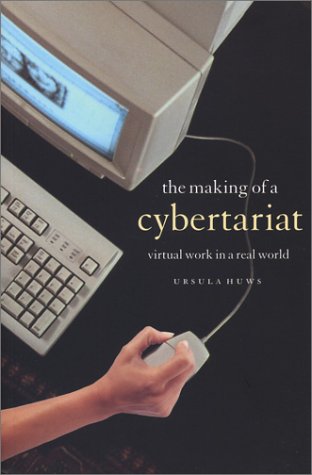
The Making of a Cybertariat: Virtual Work in a Real World
$18.95
Paperback, 208 pages
ISBN: 1-58367-088-2
Released: July 2003
The workplace has been changed in recent decades by the rise of digital technologies. Parts of a single labor process can be moved around the world, with implications not only for individual workplaces or firms, but for the working class as a whole. Computer operators in India process medical transcriptions for doctors in the United States at one-eighth of what U.S. computer operators would earn, and at four times the salary of an Indian schoolteacher.
Within advanced capitalist countries, the workplace has been made more “flexible” through cellphones, e-mail, freelancing, and outsourcing. The same process often makes the situation of the worker more precarious, as they are forced to pay for the tools of their trade, made constantly accessible to the demands of the workplace, and isolated from their fellow-workers.
Huws’ Making of a Cybertariat examines this process from a number of perspectives. It focuses especially on women in the workplace and at home. It examines changing categories of employment, and modes of organization. It shows how new divisions of race and gender are created in the process, and sets out an agenda for negotiating them. It explores the ways in which traditional forms of organization are being reshaped, and questions how the emerging cybertariat can become conscious of their common interests and stand together to struggle for them.
The Making of a Cybertariat is both a testament to the author’s remarkable record in the politics of technology over several decades, and a vital resource for grasping ongoing controversies in this field.
These essays chart the transformation of work and technology with an acute theoretical originality. Ursula Huws has the rare ability to cut through existing abstract models with a clarity based on an immense practical understanding. The implications of The Making of a Cybertariat are far reaching in rethinking a radical strategy for the future.
The moments when a fresh impulse is given to the social sciences by an original spirit deserve to be celebrated, and making the feminist political economy of Ursula Huws available to a wider public is such a moment.
Author of Market-Driven Politics
Ursula Huws is without peer as an analyst of life in contemporary capitalism. Her range of knowledge and experience is breathtaking. . . . Her ability to understand the revolution in microeletronic technology and connect it to the transformations of work, the restructuring of gender and class, and the commodification of every facet of social life exemplifies what feminist political economy can do at its very best. . . . Not only a truly educational experience but also a thoroughly enjoyable one.
Huws is in the myth-busting business. She does it with razor-sharp analysis and wit.
Contents
Foreword by Colin Leys
Introduction
- New Technology and Domestic Labor
- Domestic Technology: Liberation or Enslavement?
- Terminal Isolation: The Atomization of Work and Leisure in the Wired Society
- The Global Office: Information technology and the Relocation of White Collar Work
- Challenging Commodification: Producing Usefulness Outside the Factory
- Women’s Health at Work
- Telework: Projections
- The Fading of the Collective Dream: Reflections on Twenty Years of Research on Women and Technology
- Material World: The Myth of the Weightless Economy
- The Making of a Cybertariat: Virtual Work in a Real World
- Who’s Waiting?: The Contestation of Time
Notes
Index
The essays in The Making of a Cybertariat previously appeared in the following publications:
“Domestic Technology: Liberation or Enslavement?” Scarlet Women, No. 14, January 1982.
“Terminal Isolation: The Atomization of Work and Leisure in the Wired Society,” Making Waves, Radical Science 16, Winter/Spring 1985.
“The Global Office: Information technology and the Relocation of White Collar Work,” Third World Trade and Technology Conference Papers, Third World Information Network, 1985.
“Challenging Commodification: Producing What’s Useful Outside the Factory,” Very Nice Work If You Can Get It, Spokesman, 1985.
“Women, Health, and Work,” Silent Health, Camerawork, 1990.
“Telework: Projections,” Futures, January 1991.
“Material World: The Myth of the Weightless Economy,” Socialist Register 1999, Merlin Press/Monthly Review Press.
“The Making of a Cybertariat: Virtual Work in a Real World,” Socialist Register 2001, Merlin Press/Monthly Review Press.
Publication Date: July 2003
Number of Pages: 208
Paperback ISBN: 9781583670880
Related products
-

Monthly Review Volume 2, Number 2 (June 1950) [PDF]
$10.00 Add to cart -
Monthly Review Volume 1, Number 10 (February 1950) [PDF]
$10.00 Add to cart -

Monthly Review Volume 1, Number 7 (November 1949) [PDF]
$10.00 Add to cart -

Monthly Review Volume 1, Number 5 (September 1949) [PDF]
$10.00 Add to cart -
Monthly Review Volume 1, Number 2 (June 1949) [PDF]
$10.00 Add to cart -

Monthly Review Volume 1, Number 1 (May 1949) [PDF]
$10.00 Add to cart
 [PDF].jpg)
 [PDF].jpg)
 [PDF].jpg)
 [PDF].jpg)
 [PDF].jpg)