|
|
|
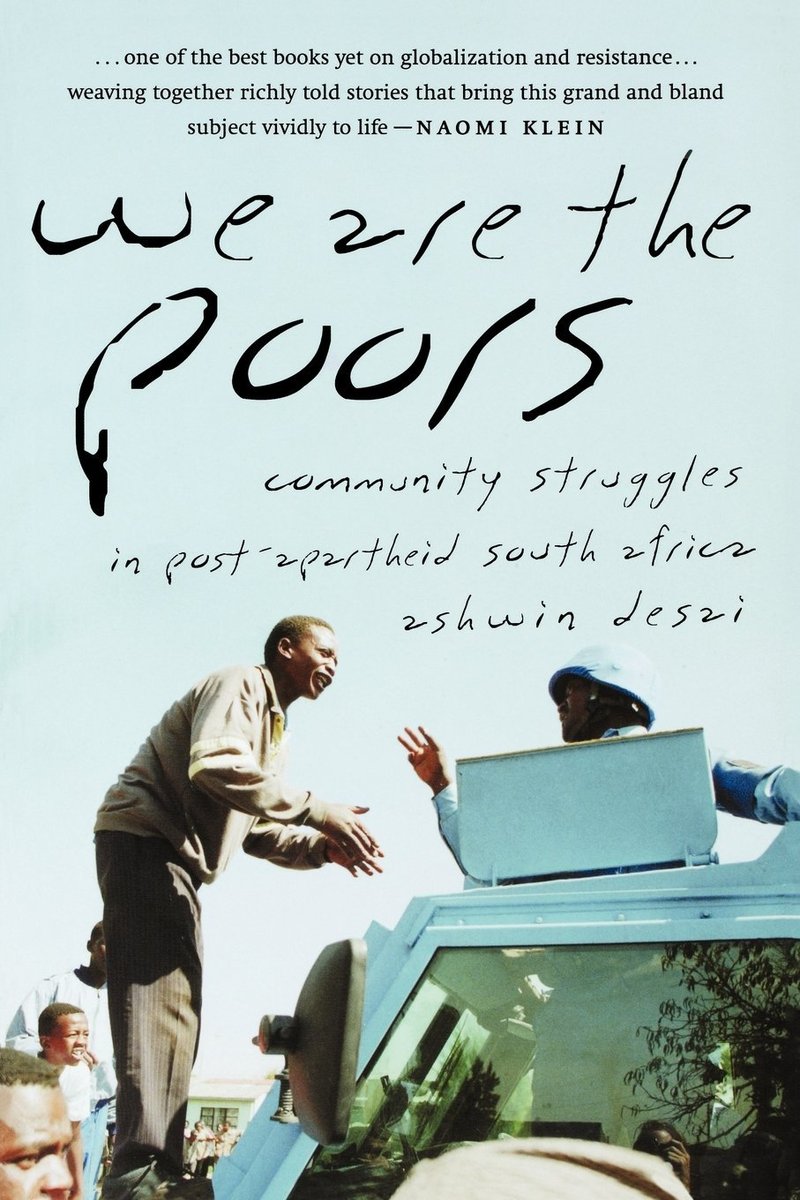
WE ARE THE POORS: COMMUNITY
STRUGGLES by Ashwin Desai All material copyright © 2002 by Monthly Review Press |
|
| « MRP Home July 2002 |
Introduction The story told in this book begins in Chatswortha township on the outskirts of Durban, the largest city on the eastern seaboard of South Africa. It describes an ongoing spiral of struggle against market-driven measures to make residents of poor communities become paying customers in a capitalist society supposedly made non-racial by the defeat of apartheid and by the embrace of the free market in its place. This struggle has spread from Chatsworth to other poor communities around Durban, and to other parts of South Africa. To say that this struggle begins in Chatsworth is a kind of shorthand, which saves the trouble of explaining each time that, like all revolts that grow, it has many beginnings. It could surely have been traced back to other sources. Even so, there are good reasons to begin in Chatsworth. When I started writing this story, Chatsworth was both a place and a struggle. It should become apparent as the story unfolds that Chatsworth has also become a politics. Race and class, the old chestnuts, still loom large. But new political variants have emerged, happily immune to infection by Robben Islanders, exiles, and ethnic entrepreneurs; the ruling post-apartheid political faction. Unemployed, single mother, community defender, neighbor, factory worker, popular criminal, rap artist and genuine ou (good human being). These constructs have all come to make up the collective identities of “the poors.” The struggle in Chatsworth helped to ignite rebellions in other areas, and to illuminate struggles already happening elsewhere. These struggles, at first conducted in isolation from each other, have begun to jump the firebreaks of race and place. Will they continue to do so, and incinerate the fetters of old political allegiances and class compromise that have so immobilized us these last ten years? Or will the multitude be confined to the outer reaches of society doused by brigades of politicians, past masters of turning on and off the taps of struggle and expectation? Or will they stand side-by-side and in so doing light the way to a new society? These hidden struggles have been epic, because they have taken guts and imagination. Above all, before a new basis of solidarity could emerge, the ethnic handicap had to be overcome. Chatsworth itself was created as a dumping ground for people classified as Indian by the apartheid system, and most of the people who live there are Indian. This made participants vulnerable to race baiting. They were Indians dissatisfied with an African government. As events have unfolded, it has become apparent that this ethnic dimension has been a blessing. It bestowed upon people crude accusations from desperate politicians. These accusations, the people considered and then rejected with the formulation of counter-identities. As these upsurges have spread to African communities like Mpumalanga, colored communities like Wentworth and Tafelsig, so these new identities have been strengthened and attempts to divide-and-rule are met more with laughter than concern. The visible part of these struggles, mass mobilization, began hesitantly. To grow, they required political and organizational innovation. Community leaders were marked with the labels of agitator, radical, and counterrevolutionary, used interchangeably. It was difficult to respond. Memories of past traditions of resilience and resistance had to be filtered through new buzzwords and adapted to changed conditions. The easy moral satisfaction of the anti-apartheid struggle was absent. Petit bourgeois support was slim and legal aid and foreign funding unheard of. Against a new democratic government, different boundaries to struggle had to be observed and, when breached, then breached with force rather than violence. Remarkable political aptitudes developed. Linkages with niche allies, in hundreds of little engagements, were supremely expedient. The enemy was mocked, praised, lobbied, fought, voted for, slandered, borrowed from, set-up, debated, and chased away. All principle flowed from the need to ward off evictions, water disconnections and the like. No bridge was unnecessarily burnt. However, this instinct for survival also meant that concessions were made and public pronouncements could become politically murky. Cultural and religious innovation, too, played a role. People cast about for theologies they could put to work. Religious ceremonies were decoded and given very contemporary moral force. In this way, hip-hop, bhangra, and the festival of (no) lights (Diwali) shared a platform, receiving applause and militant acclaim. Local icons were born with extensive reach into a youth subculture that ran on attitude rather than ideology. And for the “ordinary” people, the residents with biographies disfigured by poverty, it was discovered that no speech, workshop, or meeting could heal old wounds as healthily as did the labor around the now ubiquitous communal cooking pot. History also was drawn upon to generate the charge necessary to keep the politics of the poor alive. Having pride of place in many a home in Chatsworth or Isipingo, there are photographs of grandparents as slaves and parents as sweat-shop workers. In these places people take pride in the knowledge that a moral giant, Gandhi, whose creed was anti-imperialist, once lived among them. Then there are memories of the student militants, the bombmakers, the unionists, the intellectuals of the struggle who showed how resistance to oppression could be forged. The ringing question carries its own sharp answer: is this what they fought for? These struggles have taken place against the grain of every political party. People came to see that lobbying and due process was a futile fob-off when live ammunition was fired at them while they were begging for just thirty minutes more to obtain a court order preventing their eviction. Although tragedy constantly haunts those who operate in Chatsworth, the heavy- handed response of authorities has been a blessing. It has founded a politics that is unrepentant and unusually clear. In short, the struggles described here had to face the huge obstacle of fighting against those who wore the mantle of liberationthe African National Congress (ANC), in the first placeand thus had to undertake the task of forging very new weapons of liberation. It is worth dwelling on this difficulty. At first, communities were slow to respond to evictions and water and electricity cut-offs. Their protests were not driven by ideology but by the need to survive and the desire to live decently. Initially, action took the form of pleas for mercy in the knowledge that this was a liberation movement in power. But the response was that payment had to be made. This was the policy, they were told. The prestige and power of the ANC was such that many felt it was impossible to oppose their policies, or that opposition could only be couched in terms of loyalty to the vision of the ANC itself. Many readers of this book will be familiar with the dramatic change in government in South Africa during the 1990s. In 1994 the ANC stepped off the back of a popular trade union and community-driven revolt against racial capitalism and into power. The revolt against apartheid had been bravely militant, resolutely socialist, and waged with the support of progressive internationalists around the world. The price of its triumph was paid in blood and broken childhoods. The conviction that all this suffering would be redeemed was affirmed at every surging funeral and in the sweat, beer, and tears that drew people into each others arms at the end of every back street jazz concert. Every teenage struggle poet promised that the blood would water the tree of freedom. The multitude was a network of rivers. Rushing out of schools, factories, and universities. Parting, joining, growing. It crashed through every wall the system had ever built. It ate razor wire, hit the police straight back, refused the chief, looked the future straight in the eye. The farmer's fences were now just wire and the soldiers were just scared teenagers. Anything could happen when one was between the broken and the built. The cities were shaking with our feet. Even white teenagers had learned to burn. But this revolt had a flaw. The multitude that brought down the apartheid regime had a millennial faith in the exiled and imprisoned leadership of the ANC. The multitude that brought that ANC to power with millions of acts of rebellion, from strikes to burning barricades to refusing to stay and pay and obey, became a (just slightly fractious) people under the ANC. Before long, democracy was more or less stifled within the ANC and its Communist and trade union allies. People that couldn't be bought were marginalized. It soon got to the point where you could get expelled from the South African Communist Party for advocating Communism. Once the conservative nationalists had cemented their hegemony within the party self-serving deals were done with local white elites and international capital. By 1996 Thabo Mbekithen deputy president of South Africa, later successor to Nelson Mandela as leader of the ANC and president of South Africawas calling himself a Thatcherite and the ANC had voluntarily imposed its own structural adjustment program on South Africa. Taxes on the rich were cut, exchange controls dropped, and tariffs protecting unionized South African workers from imports from sweat shops were abandoned. Around a hundred thousand jobs were lost each year and a million alone in 2001. Water, electricity, housing and health care were taken from those who couldn't pay. The white elite was allowed to move its corporate assets to London and a small black elite made up of around 300 families became super rich. Unemployment reached 40 percent and by every measure (life expectancy, morbidity, access to food, water, etc.) the living conditions of the poor rapidly worsened. Heretical statistics, I know. Scattered resistance to market fundamentalism was dealt with brutally. On May 16, 2000, Michael Makabane was shot dead at point-blank range during a peaceful protest against the exclusion of poor students from the University of Durban-Westville. That campus had been considered a hotbed of militant resistance to apartheid. While police repression had been brutal no students had ever been killed during the apartheid era. The local paper, now under black editorship, called for “tougher” action against protesting students (Daily News, May 17, 2000). By 2002 over 6 million South Africans were HIV positive and without any access to the lifesaving medication that, even a not completely rabid neo-liberal budget, could safely satisfy. People were aghast at a comment made by the president's spokesperson that medicines that prevented mother-to-child transmission of the virus were undesirable because of the healthy orphans it left the state to deal with. The majority of the population are living on less than R140 (about $15) per month.(1) One in four black children do not have enough to eat every day. Only 3 percent of arable land had been redistributed and much of that had been given to black commercial farmers and not to landless peasants. Over a million people had been disconnected from water because they couldn't pay; 40,000 children were dying from diarrhea caused by dirty water each year. Cholera returned with a vengeance, infecting over 100,000 people in Kwa-Zulu Natal alone. People starved in rural areas, throngs of street-kids descended on every town to beg and prostitute themselves, petty-crimes soared, and the jails reached 170% capacity. It was in these contradictory circumstanceswith a government elected by the oppressed majority and using that power to carry out the program of big capitalthat people began defending their homes from the private security companies hired to effect the state's eviction notices. Trade union and church leaders were speaking truth to power. Small groups were meeting in dingy offices bequeathed to the poor by white flight to gated suburbs, London and Sydney. They were discussing strategy, learning to say “Phansi ANC! Phansi!” (Down with the ANC! Down!) and planning meetings, strikes, and marches. Rivulets of humanity were back on the streets demanding land, a basic income grant, anti-AIDS medication, a halt to privatization, and dignity. The betrayal of the South African liberation struggle has been documented by scholars like Dale McKinley, Hein Marais, Patrick Bond, and John Saul.(2) Anyone who wants to hold on to the fantasies of South Africa as a liberated zone should read their books. The dirty deals have been recorded and the numbers are all there. This is a different kind of book. It aims to give some account of the lived experience of both the human cost of the ANC's capitulation to domestic and international capital and the growing resistance to the ANC. Especially, it hopes to express the conditions for the emergence of such a struggle and communicate the terms upon which it is taking place, for there is something special and encouraging at this level too. You will meet in this book Sifiso Sithole. He is sixteen years old and from Soweto. He belongs to the Soweto Electricity Crisis Committee (SECC) that sponsors Operation Khanyisa (“To light up”). Sifiso is part of a hunted band of people who reconnect electricity to the homes of those who are too poor to pay the bills of the busy-being-privatized utility Eskom. You will hear the story of Jasmine Samsodien. She lives at number 35 Heuningberg in Tafelsig, Cape Town. She turned to the Tafelsig Anti-Eviction Committee when police and council employees arrived to evict her in September 2001. Prevented from doing so by a mass uprising, the following month the council authorities cut her water and thereby a lifeline to her four children and three grandchildren. The inspirational response of the people of the Cape Flats is recorded in these pages. Binisle Mzeku worked at Volkswagen South Africa in Uitenhage in the Eastern Cape for over a decade. At the beginning of 2000 he was one of 3,000 workers who went on strike against their own union. At issue was the sweetheart decision of National Union of Metalworkers of South Africa (NUMSA) to sign an agreement with management that eroded many shopfloor gains in the bloody battles of the 1980s. At about the time Binisle heard from the Labour Appeal Court that he and over a thousand others had lost their jobs, Jane Smith was part of a union that participated in an illegal strike against the huge multinational, Engen, in Durban's South basin. The strike was about the casualization of labor, pollution and environmental degradation, and above all, as one worker put it, about dignity. It was a unique kind of strike as the whole community of Wentworth rose up to support the strikers whose own identity was transformed by the support they received. In Chatsworth, Thulisile Christina Manqele lives in 173 Glenover Road, Block 92. Unemployed, desperately ill, with seven children to care for, her electricity and water were disconnected for non-payment. She turned to her neighbors in the Westcliff Flat Resident's Association. They turned for relief to the courts who had the job of interpreting the socioeconomic clauses in the supposedly “most progressive constitution in the world.” The judges, though, found a clever way to look the other way and the community then took matters into their own hands. They have been illegally reconnecting water and fighting off the city council security men every time they have come to impose law and order since then. Many of the different threads of struggle described in this book came together in August and September 2001, in massive protests against the South African government as it hosted the showpiece World Conference Against Racism, held in Durban. Community organizations came together and South Africa and the world had a new social movement to deal with, the Durban Social Forum. Although the book follows events no further, they have not come to a halt. The birth of a movement is described in this book. So much depends on it as we go into the future. The response of the state to all these struggles has been uncompromising and brutal, ranging from vicious assaults, arrests, and the fabricating of charges and the labeling of activists as criminals. But paradoxically, the life of people in these communities has become increasingly sensuous. An active sense of community pervades. Spaces for living that are not bonded to the dollar sign have been carved open and are jealously protected while new ways of struggling that value human needs and desires are being imagined. These are fragile times and yet the scraggly kitten has already all the fierceness of a lynx. All these community movements from Tafelsig in the Western Cape, to Soweto in Gauteng, and Chatsworth in Durban are signposts of something in South Africa. They are the force behind what has been called “South Africa's new revolution”a revolution captured by Jon Jeter in these terms: “Seven years after voters of all races went to the polls for the first time, ending 46 years of apartheid and white rule, churches, labor unions, community activists and the poor in all-black townships are dusting off the protest machinery that was the engine of their liberation struggle. What most provokes South Africans defiance today are what they see as injustices unleashed on this developing nation by the free-market economic policies of the popularly elected, black-led governing party, the African National Congress” (Washington Post, November 6, 2001). The events narrated below reveal how struggle in the new South Africa may be rediscovered and re-created. But the story is not told in abstract terms. This is first and foremost an account from the frontlines of the establishment's undeclared war on the poor. It is, I am told, a heartening report because the war seems no longer to be one-sided. Notes
|
|