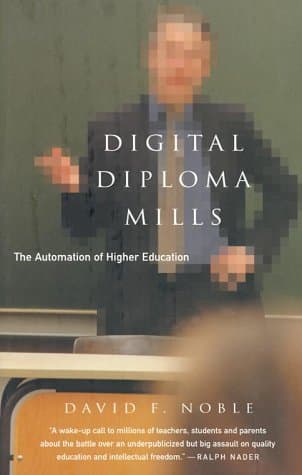
Digital Diploma Mills: The Automation of Higher Education
$16.00
Is the Internet the springboard which will take universities into a new age, or a threat to their existence? Will dotcom degrees create new opportunities for those previously excluded, or lead them into a digital dead-end? From UCLA to Columbia, digital technologies have brought about rapid and sweeping changes in the life of the university—changes which will have momentous effects in the decade ahead.
In the first book-length analysis of the meaning of the Internet for the future of higher education, David Noble cuts through the rhetorical claims that these developments will bring benefits for all. His analysis shows how university teachers are losing control over what they teach, how they teach and for what purpose. It shows how erosion of their intellectual property rights makes academic employment ever less secure. The academic workforce is reconfigured as administrators claim ownership of the course-designs and teaching materials developed by faculty, and try to lower labor costs in the marketing and delivery of courses.
Rather than new opportunities for students the online university represents new opportunities for investors to profit while shifting the burden of paying for education from the public purse to the individual consumer—who increasingly has to work long hours at poorly-paid jobs in order to afford the privilege. And this transformation of higher education is often brought about through secretive agreements between corporations and universities—including many which rely on public funding.
Noble locates recent developments within a longer-term historical perspective, drawing out parallels between Internet education and the correspondence course movement of the early decades of the 20th century. This timely work by the foremost commentator of the social meaning of digital education is essential reading for all who are concerned with the future of the academic enterprise.
David Noble spells out the meaning of the automation of higher education in terms of academic freedom, civic values, and the distortions of research, curriculum and tuition on campus. Noble knows more than anyone about the growing struggle by faculty and students in North America against these erosions. Digital Diploma Mills is a wake-up call to millions of teachers, students, and parents about the battle over an underpublicized but big assault on quality education and intellectual freedom.
David Noble’s critique of technology has never been more forceful—or more usable for faculty—than in his writing on distance education. This collection of his ideas is a succinct and brilliantly pointed antidote to cyber hype. Most of all, its force derives from a passionate attachment to the notion of education as a vital human compact between individual, in-the-flesh students and teachers.
Digital Diploma Mills is essential reading for faculty union activists and others struggling to understand and combat the increasing corporatization of our universities. David Noble outlines the dismal future toward which higher education seems to be headed, but even more important, he eloquently reminds us of our obligation to forestall that future and to preserve the promise that genuine education entails.
David Noble has done it again. Digital Diploma Mills provides a penetrating analysis of how the marriage between new technologies and the corporate search for profits shapes what happens in the classrooms of higher learning. This is essential reading not only for those who care about the pursuit of truth in an autonomous academy, but for all who are concerned with the growing corporate encroachments in virtually every sphere of our existence.
David Noble’s insightful book sounds a sobering warning. If digital education becomes just another fast-food commodity, students and teachers will lose, while higher education becomes further entrenched in corporate big business. Digital Diploma Mills should be required reading for educators and others interested in the brave new world of online education.
Publication Date: March 2003
Number of Pages: 128
Paperback ISBN: 9781583670927
Related products
-
![Monthly Review Volume 2, Number 4 (August 1950) [PDF]](data:image/svg+xml,%3Csvg%20xmlns='http://www.w3.org/2000/svg'%20viewBox='0%200%20150%20239'%3E%3C/svg%3E)
Monthly Review Volume 2, Number 4 (August 1950) [PDF]
$10.00 Add to cart -
Monthly Review Volume 2, Number 2 (June 1950) [PDF]
$10.00 Add to cart -
Monthly Review Volume 1, Number 8 (December 1949) [PDF]
$10.00 Add to cart -
![Monthly Review Volume 1, Number 7 (November 1949) [PDF]](data:image/svg+xml,%3Csvg%20xmlns='http://www.w3.org/2000/svg'%20viewBox='0%200%20150%20229'%3E%3C/svg%3E)
Monthly Review Volume 1, Number 7 (November 1949) [PDF]
$10.00 Add to cart -
![Monthly Review Volume 1, Number 5 (September 1949) [PDF]](data:image/svg+xml,%3Csvg%20xmlns='http://www.w3.org/2000/svg'%20viewBox='0%200%20150%20232'%3E%3C/svg%3E)
Monthly Review Volume 1, Number 5 (September 1949) [PDF]
$10.00 Add to cart -

We, the People: The Drama of America
Price range: $15.00 through $18.00 Select options This product has multiple variants. The options may be chosen on the product page
![Monthly Review Volume 2, Number 4 (August 1950) [PDF]](https://monthlyreview.org/wp-content/uploads/2015/09/Monthly Review Volume 2, Number 4 (August 1950) [PDF].jpg)
![Monthly Review Volume 2, Number 2 (June 1950) [PDF]](https://monthlyreview.org/wp-content/uploads/2015/09/Monthly Review Volume 2, Number 2 (June 1950) [PDF].jpg)
![Monthly Review Volume 1, Number 8 (December 1949) [PDF]](https://monthlyreview.org/wp-content/uploads/2015/09/Monthly Review Volume 1, Number 8 (December 1949) [PDF].jpg)
![Monthly Review Volume 1, Number 7 (November 1949) [PDF]](https://monthlyreview.org/wp-content/uploads/2015/09/Monthly Review Volume 1, Number 7 (November 1949) [PDF].jpg)
![Monthly Review Volume 1, Number 5 (September 1949) [PDF]](https://monthlyreview.org/wp-content/uploads/2015/09/Monthly Review Volume 1, Number 5 (September 1949) [PDF].jpg)