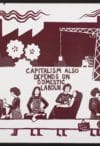
Reviewing Smitha Radhakrishnan’s Making Women Pay, Jingyi Zhang elucidates the exploitative practices of the much-vaunted microfinance industry, particularly as they apply to—and exacerbate—existing tensions within communities of women in India. | more…
“It is surprising,” Marnie Holborow writes, “how often in Marxist accounts of women’s oppression Frederick Engels is overlooked.” In responding to this gap in analysis, Holborow examines his influential work, The Origin of the Family, Private Property and the State, finding his observations on gender roles and social reproduction under capitalism—and their expressions based on class—are not only astute for Engels’s time, but very much for ours as well. | more…
Using the lens of Neeraj Ghaywan’s film Geeli Pucchi, Aratrika Bose, Tanupriya, and Anuja Singh explore the ways in which lesbian characters negotiate the trappings of hegemonic femininity embedded in Indian culture, from marriage and home life to the workplace, and the role of the body and “beauty” in the navigation of feminine identities. | more…
Tomás Mac Sheoin reviews Road to Repeal, which documents the struggle for abortion rights in Ireland, from its constitutional prohibition to the ban’s repeal in 2018. | more…
Two years after the peak of the 2020 street protests for reproductive rights in Poland, Magdalena Muszel and Grzegorz Piotrowski explore the movement’s effects on Polish society. Despite the dissipating energy of the participants and continued intransigence of most major parties, this cycle of protests shifted the values and political preferences of specific gender and age groups, as well as affecting the common perception of protest movements in Poland. | more…
Eleanor Burke Leacock taught that transhistorical, universal male dominance is a myth, not a fact. Writing during the grimmest period of Cold War reaction, Leacock put forward a critique of the mainstream U.S. ideology, which took for granted the idea that there were only two genders, in binary opposition to each other, and that these were the direct product of so-called male and female nature. | more…
While later generations of Marxian scientific socialists saw sex as secondary, derivative of the real relationships of production, many of the earliest socialist theorists and movements took sexual matters very seriously. Thus, in many ways, the advent of Marxian socialism represented something of a step backward in the development of a radical sexual politics. However, in the twentieth century, old divisions on the sex question within the left soon reappeared. | more…
There is an unresolved tension at the heart of Marxist explanations for women’s oppression under capitalism. Although there is general agreement that the bourgeois family, as the dominant kinship unit, has something to do with generating and reproducing that oppression, the exact role of the family varies among Marxists. In this respect, Margaret Benston’s proposal to situate domestic labor within capitalist production was truly pioneering. Rather than record and describe domestic work, Benston theorized this labor and laid the basis for later feminists to apprehend the production of commodities and the reproduction of labor power within a unitary framework. | more…
This special issue of Monthly Review honors the fiftieth anniversary this month of Margaret Benston’s landmark “The Political Economy of Women’s Liberation.” The essay sparked a revolution in Marxian thought, the full implications of which are only now being perceived in contemporary social reproduction theory. We have reprinted Benson’s pieces together with contributions by Silvia Federici, Martha E. Gimenez, Selma James (interviewed by Ron Augustin), Leith Mullings, Marge Piercy, and Lise Vogel, all of whom have played leading roles since the 1970s in the development of feminist historical materialism. | more…
In sheer quantity, household labor, including child care, constitutes a huge amount of socially necessary production. Nevertheless, in a society based on commodity production, it is not usually considered “real work” since it is outside of trade and the market place. This assignment of household work as the function of a special category women means that this group does stand in a different relation to production than the group men. Except for the very rich, who can hire someone to do it, there is for most women, an irreducible minimum of necessary labor involved in caring for home, husband, and children. Household work remains a matter of private production. | more…
In the late 1960s, the North American women’s liberation movement was reaching a highpoint of activity, its militancy complemented by a flourishing literature. This was the environment into which Margaret Benston’s 1969 Monthly Review essay, “The Political Economy of Women’s Liberation,” struck like a lightning bolt. At the time, many in the movement were describing women’s situation in terms of sociological roles, functions, and structures—reproduction, socialization, psychology, sexuality, and the like. In contrast, Benston proposed an analysis in Marxist terms of women’s unpaid labor in the family household. In this way, she definitively shifted the framework for discussion of women’s oppression onto the terrain of Marxist political economy. | more…
The question of the oppression of women, the critique of which constituted feminism as an academic and political pursuit, has been feminism’s enduring source of strength and appeal, yielding numerous critical theories and perspectives. This has produced continual conceptual shifts defining an evolving feminism, such as the shift from women to gender and from inequality to difference. It has also involved shifts from theorizing the general conditions of women’s experience—oppressed at home and in the workplace, while juggling the conflicting demands of both—to theorizing the implications of the claim that, while gender may be the main source of oppression for white, heterosexual, middle-class women, women with different characteristics and experiences are affected by other forms of oppression as well. A possible way for Marxist feminism to remain a distinctive theoretical and politically relevant perspective might be to return to class, in the Marxist sense, theoretically reexamining the relationship between class and oppression, particularly the oppression of working-class women, within capitalist social formations. | more…








 [PDF]-100x146.jpg)