| «
MRP Home
ISBN:
1-58367-012-2
$18.00 paper
ISBN:
1-58367-011-4
$48.00 cloth
288 pp.
March 2000
also by
John Bellamy Foster:
THE VULNERABLE PLANET
|
Excerpt
Preface
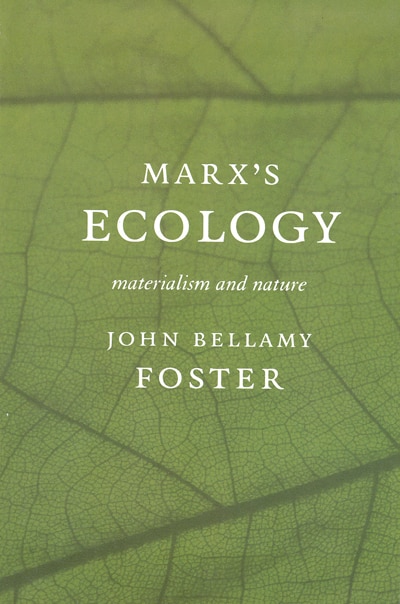
The original title for this book, at its inception, was Marx and
Ecology. At some point along the way the title changed to Marxs
Ecology. This change in title stands for a dramatic change in my thinking
about Marx (and about ecology) over the last few years, a change in which
numerous individuals played a part.
Marx has often been characterized as an anti-ecological thinker. But I was
always too well acquainted with his writing ever to take such criticisms
seriously. He had, as I knew, exhibited deep ecological awareness at numerous
points in his work. But at the time that I wrote The
Vulnerable Planet: A Short Economic History of the Environment (1999, 2nd
Edition), I still believed that Marx's ecological insights were somewhat
secondary within his thought; that they contributed nothing new or essential to
our present-day knowledge of ecology as such; and that the importance of his
ideas for the development of ecology lay in the fact that he provided the
historical-materialist analysis that ecology, with its generally ahistorical
and Malthusian notions, desperately needed.
That it was possible to interpret Marx in a different way, one that
conceived ecology as central to his thinking, was something that I was
certainly aware of, since it was raised day after day in the 1980s by my friend
Ira Shapiro, New York-expatriate, farmer, carpenter, working-class philosopher,
and at that time a student in my classes. Going against all the conventions in
the interpretation of Marx, Ira would say to me look at this,
pointing to passages in which Marx dealt with the problems of agriculture and
the circulation of soil nutrients. I listened attentively, but did not yet
appreciate the full import of what I was being told (in this I was no doubt
held back, in contrast to Ira, by the fact that I had no real experience in
working the land). In these same years, my friend Charles Hunt, radical
activist, sociologist, part-time professor, and professional beekeeper, told me
that I should become better acquainted with Engels Dialectics of
Nature, because of its science and its naturalism. Again I listened, but
had my hesitations. Wasnt the dialectic of nature flawed from
the outset?
My path to ecological materialism was blocked by the Marxism that I had
learned over the years. My philosophical grounding had been in Hegel and the
Hegelian Marxist revolt against positivist Marxism, which began in the 1920s in
the work of Lukács, Korsch, and Gramsci, and which had carried over into
the Frankfurt School and the New Left (part of the much greater revolt against
positivism that dominated European intellectual life from 1890 to 1930 and
beyond). The emphasis here was on Marxs practical materialism, rooted in
his concept of praxis; which in my own thinking came to be combined with the
political economy of the Monthly Review tradition in the United States,
and the historical-cultural theories of E.P. Thompson and Raymond Williams in
England. There seemed little room in such a synthesis, however, for a Marxist
approach to issues of nature and natural-physical science.
It is true that thinkers like Thompson and Williams in England, and Sweezy,
Baran, Magdoff, and Braverman associated with the Monthly Review in the
U.S., all insisted on the importance of connecting Marxism to the wider
natural-physical realm, and each contributed in his way to ecological thinking.
But the theoretical legacy of Lukács and Gramsci, which I had
internalized, denied the possibility of the application of dialectical modes of
thinking to nature, essentially ceding that entire domain to positivism. At the
time, I was scarcely aware of an alternative, more dialectical tradition within
the contemporary life sciences, associated in our time with the work of such
important thinkers as Richard Lewontin, Richard Levins, and Stephen Jay Gould.
(When this awareness finally did dawn on me, it was a result of Monthly
Review, which has long sought to link Marxism in general back up with the
natural and physical sciences.) Nor was I yet acquainted with the critical
realism of Roy Bhaskar.
To make matters worse, like most Marxists (outside of the biological
sciences, where some of this history was retained), I had no knowledge of the
real history of materialism. My materialism was entirely of the practical,
political-economic kind, philosophically informed by Hegelian idealism and by
Feuerbachs materialist revolt against Hegel, but ignorant of the larger
history of materialism within philosophy and science. In this respect the
Marxist tradition itself, as it had been passed down, was of relatively little
help, since the basis on which Marx had broken with mechanistic materialism,
while remaining a materialist, had never been adequately understood.
It is impossible to explain the stages (except perhaps by pointing to the
argument that follows) of how I finally came to the conclusion that Marxs
world-view was deeply, and indeed systematically, ecological (in all positive
senses in which that term is used today), and that this ecological perspective
derived from his materialism. If there was a single turning point in my
thinking, it began shortly after The Vulnerable Planet was published
when my friend John Mage, radical lawyer, classical scholar, and Monthly
Review colleague, said that I had made an error in my book and in a
subsequent article in tentatively adopting the Romantic Green view that
capitalisms anti-ecological tendencies could be traced in considerable
part to the scientific revolution of the seventeenth century, and in particular
to the work of Francis Bacon. John raised the question of the relation of Marx
to Bacon, and the historical meaning of the idea of the domination of
nature that emerged in the seventeenth century. Gradually, I realized
that the whole issue of science and ecology had to be reconsidered from the
beginning. Among the questions that concerned me: Why was Bacon commonly
presented as the enemy within Green theory? Why was Darwin so often
ignored in discussions of nineteenth-century ecology (beyond the mere
attribution of social Darwinist and Malthusian conceptions to him)? What was
the relation of Marx to all of this?
I concluded early on in this process that attempts by
ecosocialists to graft Green theory on to Marx, or Marx on to Green
theory, could never generate the organic synthesis now necessary. In this
respect I was struck by Bacons famous adage that, We can look in
vain for advancement in scientific knowledge from the superinducing and
grafting of new things on old. A fresh start (instauratio) must be made,
beginning from the very foundations, unless we want to go round for ever in a
circle, making trifling, almost contemptible progress (Novum
Organum). The problem then became one of going back to the foundations of
materialism, where the answers increasingly seemed to lie, reexamining our
social theory and its relation to ecology from the beginning, that is,
dialectically, in terms of its emergence.
What I discovered, much to my astonishment, was a story that had something
of the character of a literary detective story, in which various disparate
clues led inexorably to a single, surprising, source. In this case, the
materialism of Bacon and Marx, and even that of Darwin (although less
directly), could be traced back to a common point of origin: the ancient
materialist philosophy of Epicurus. Epicurus role as the great
Enlightener of antiquitya view of his work that was shared by thinkers as
distinct as Bacon, Kant, Hegel, and Marxprovided me for the first time
with a coherent picture of the emergence of materialist ecology, in the context
of a dialectical struggle over the definition of the world.
In a closely related line of research, I discovered that Marxs
systematic investigation into the work of the great German agricultural chemist
Justus von Liebig, which grew out of his critique of Malthusianism, was what
led him to his central concept of the metabolic rift in the human
relation to naturehis mature analysis of the alienation of nature. To
understand this fully, however, it became necessary to reconstruct the
historical debate over the degradation of the soil that had emerged in the
mid-nineteenth century in the context of the second agricultural
revolution, and that extends down to our time. Herein lay Marxs
most direct contribution to the ecological discussion (see chapter 5). I am
extremely grateful to Liz Allsopp and her colleagues at IACRRothamsted in
Hertfordshire for making Lady Gilberts translation of Liebigs
Einleitung, which lies in the Rothamsted archives, available to me.
In conducting this research I benefited from close collaboration with Fred
Magdoff and Fred Buttel in the context of coediting a special July-August 1998
issue of Monthly Review, entitled Hungry for
Profitnow expanded into book form. I also gained from the support
of my coeditor for the journal
Organization &
Environment, John Jermier. Some of this work appeared in earlier, less
developed forms in the September 1997 issue of Organization &
Environmentand the September 1999 issue of the
American Journal of
Sociology.
Given the complex intellectual history that this book attempts to unravel,
its excursions into areas as seemingly removed from each other as ancient and
modern philosophy, I was obviously in need of an interlocutor of extraordinary
talents. That role was played throughout by John Mage, whose classical
approach to knowledge, and immense historical and theoretical
understanding, is coupled with a lawyers proficiency at dialectic. There
is not a line in this book that has not been the subject of John's searching
queries. Much that is best here I owe to him, while whatever faults remain in
this work are necessarily, even stubbornly, my own.
Paul Burketts magisterial work Marx and Nature: A Red and Green
Perspective (1999) constitutes not only part of the background against
which this work was written, but also an essential complement to the analysis
provided here. If I have sometimes neglected to develop fully the
political-economic aspects of Marxs ecology, it is because the existence
of this work makes this unnecessary and redundant. Years of stimulating
dialogue with Paul have done much to sharpen the analysis that follows.
To Paul Sweezy, Harry Magdoff, and Ellen Meiksins Wood, the three editors of
Monthly Review, I am indebted for their encouragement and the force of
their example. Paul's commitment to environmental analysis was a major factor
thrusting me in this direction. Christopher Phelps, who, as Editorial Director
of Monthly Review Press, was involved with this book from its inception, has
aided me in numerous, important ways.
It goes without saying that love and friendship are essential to all that is
truly creative. Here I would like to thank Laura Tamkin, with whom I share my
dreams, and Saul and Ida Foster; and also Bill Foster and Bob McChesney. To
Saul and Ida, and their entire young generation, I dedicate this book.

If you have any technical comments or suggestions, about
this web site, please send e-mail to Our Webmaster at mrwebmaster@monthlyreview.org.
|