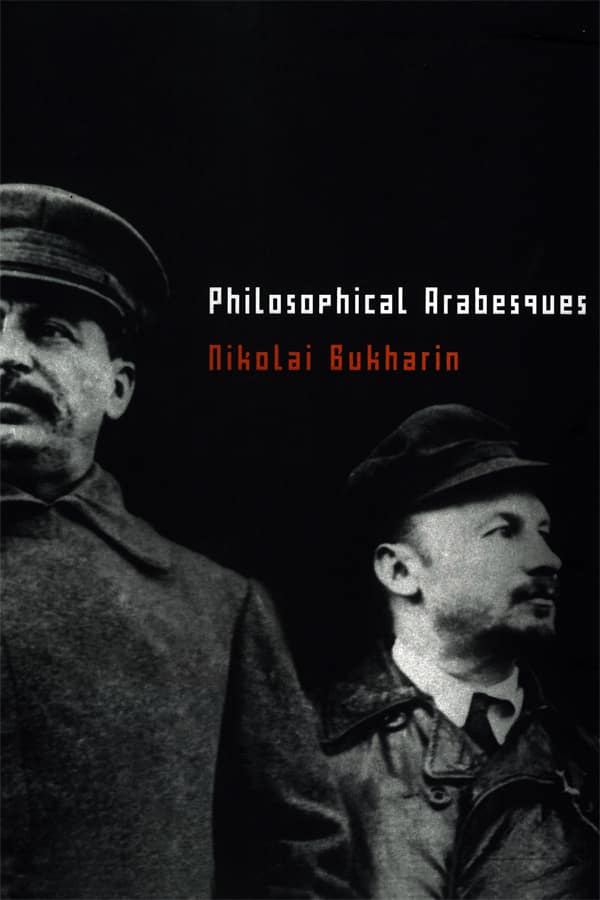
Philosophical Arabesques
Price range: $29.00 through $49.95
Bukharin’s Philosophical Arabesques was written while he was imprisoned in the Lubyanka Prison in Moscow, facing a trial on charges of treason and the likelihood of execution. After the death of Lenin, Bukharin co-operated with Stalin for a time. Once Stalin’s supremacy was assured he began eliminating all potential rivals. For Bukharin, the process was to end with his confession before the Soviet court, facing the threat that his young family would be killed along with him if he did not.
While awaiting his death, Bukharin wrote prolifically. He considered Philosophical Arabesques as the most important of his prison writings. In its pages, he covers the full range of issues in Marxist philosophy—the sources of knowledge, the nature of truth, freedom and necessity, the relationship of Hegelian and Marxist dialectic. The project constitutes a defense of the genuine legacy of Lenin’s Marxism against the use of his memory to legitimate totalitarian power.
Consigned to the Kremlin archives for a half-century after Bukharin’s execution, this work is now being published for the first time in English. It will be an essential reference work for scholars of Marxism and the Russian revolution and a landmark in the history of prison writing.
The scope of this work alone earns it a place alongside that other great Marxist work written in political incarceration, Antonio Gramsciʼs Prison Notebooks … It is a work of real philosophical interest, but also of historical importance since, among other things, it underlines the tragedy of Bukharin as a historical figure.
Forty-nine years old, a condemned man, Bukharin remained ever the intellectual, full of fire and fight for his youthful ideals even as his spirit and life’s work were under assault … Against all odds, Bukharin argued for a restoration of the humanist and democratic potential of the Soviet system, which would stand as the principal bulwark against fascist barbarism … Philosophical Arabesques was Bukharin’s respectful reply to Lenin, at once a defense of Leninist orthodoxy on ontological and epistemological issues and a challenge to the petrified official Marxism of the Stalinists. He believed that what he was doing was extremely valuable and wrote to his wife, “The most important thing is that the philosophical work not be lost. I worked on it for a long time and put a great deal into it; it is a very mature work in comparison to my earlier writings, and, in contrast to them, dialectical from beginning to end.” … Bukharin’s engagement with dialectics as a method—his focus on change and contradiction, on overcoming historically generated social institutions and intellectual practices that have taken on the appearance of natural, fixed, permanent realities—may have an unrecognized relevance more than ever in our one-dimensional present.
A highly significant historical document, and anyone interested in the Russian revolution and its fate owes a debt of gratitude to all those who were instrumental in recovering it from secret police archives and making it available in English.
Will be welcomed by those interested in the history of Marxism and the former Soviet Union, as well as those concerned to develop alternatives to global capitalism. Summing Up: Recommended.
Table of Contents
Introduction: A Voice from the Dead by Helena Sheehan
Editor’s Note
Foreword
Introduction
- The Reality of the World and the Intrigues of Solipsism
- Acceptance and Non-Acceptance of the World
- Things in Themselves and Their Cognizability
- Space and Time
- Mediated Cognition
- The Abstract and the Concrete
- Senses, Ideas, and Concepts
- Living Nature and Its Treatment in Art
- Rational Thinking, Dialectical Thinking, and Direct Contemplation
- Practice in General and Practice in the Theory of Cognition
- Practical, Theoretical, and Aesthetic Treatment of the World and Their Unity
- The Original Stands of Materialism and Idealism
- Hylozoism and Panpsychism
- Hinduist Mysticism and West European Philosophy
- The So-called Philosophy of Identity
- The Sins of Mechanistic Materialism
- The General Patterns and Links of Being
- Teleology
- Freedom and Necessity
- Organisms
- Contemporary Natural Science and Dialectical Materialism
- The Sociology of Thinking: On Work and Thinking as Two General Historical Categories
- The Sociology of Thinking: On the Method of Production and the Method of Representation
- So-called Racial Thinking
- Social Positions, Thinking, and Emotions
- The Object of Philosophy
- The Subject of Philosophy
- The Interaction between Subject and Object
- Society as an Object and a Subject of Possession
- Truth: On the Concept of Truth and Its Criterion
- Truth: On Absolute and Relative Truth
- Well-Being
- Hegel’s Dialectical Idealism as a System
- Hegel’s Dialectics and Marx’s Dialectics
- Dialectics as Science and Dialectics as Art
- Science and Philosophy
- Evolution
- Theory and History
- Social Ideals
- Lenin the Philosopher
Glossary
Index
Publication Date: June 2005
Number of Pages: 448
Cloth ISBN: 9781583671023
Paperback ISBN: 978-158367-9531
Related products
-
![Monthly Review Volume 2, Number 2 (June 1950) [PDF]](data:image/svg+xml,%3Csvg%20xmlns='http://www.w3.org/2000/svg'%20viewBox='0%200%20150%20239'%3E%3C/svg%3E)
Monthly Review Volume 2, Number 2 (June 1950) [PDF]
$10.00 Add to cart -
Monthly Review Volume 1, Number 10 (February 1950) [PDF]
$10.00 Add to cart -
Monthly Review Volume 1, Number 9 (January 1950) [PDF]
$10.00 Add to cart -

Monthly Review Volume 1, Number 1 (May 1949) [PDF]
$10.00 Add to cart -

The Theory of Capitalist Development: Principles of Marxian Political Economy
$20.00 Select options This product has multiple variants. The options may be chosen on the product page -

We, the People: The Drama of America
Price range: $15.00 through $18.00 Select options This product has multiple variants. The options may be chosen on the product page
![Monthly Review Volume 2, Number 2 (June 1950) [PDF]](https://monthlyreview.org/wp-content/uploads/2015/09/Monthly Review Volume 2, Number 2 (June 1950) [PDF].jpg)
![Monthly Review Volume 1, Number 10 (February 1950) [PDF]](https://monthlyreview.org/wp-content/uploads/2015/09/Monthly Review Volume 1, Number 10 (February 1950) [PDF].jpg)
![Monthly Review Volume 1, Number 9 (January 1950) [PDF]](https://monthlyreview.org/wp-content/uploads/2015/09/Monthly Review Volume 1, Number 9 (January 1950) [PDF].jpg)